An AI model's output quality is bounded by its training data quality. This is not a nuanced observation. It is the operational reality that every ML team confronts the moment their model starts underperforming on real-world inputs: the problem is almost never the architecture. It is the data that went in.
The AI data pipeline is the full infrastructure stack that moves raw information from its source, through cleaning, formatting, and validation, into a training or inference system. Most of the engineering attention in this space goes to the processing and training layers. The data acquisition layer, where data is collected from the web at scale, is frequently underspecified, patched together from inconsistent sources, or treated as a problem that will be solved later. It rarely is.
This article covers the anatomy of an AI data pipeline, where web data acquisition sits within it, what that layer needs to handle at production scale, and how the decisions made at collection time determine the ceiling on everything that follows.
The Anatomy of an AI Data Pipeline
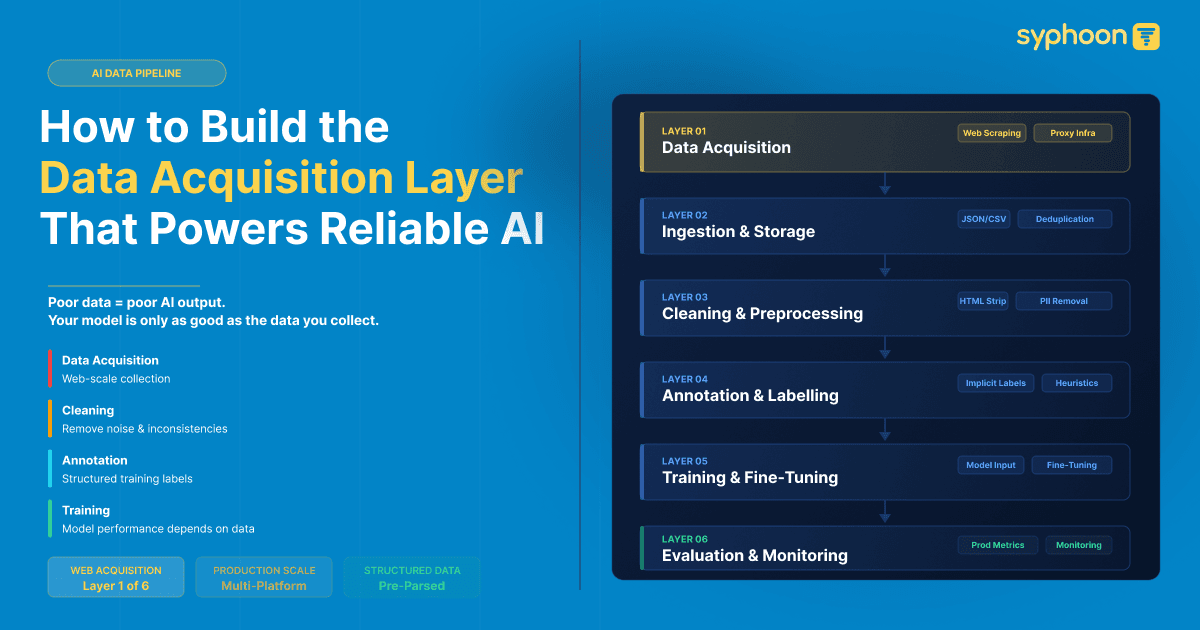
An AI data pipeline is not a single system. It is a sequence of interconnected layers, each with its own tooling requirements, failure modes, and quality standards. Understanding where each layer sits and what it does is the prerequisite for building any one of them effectively.
Layer 1: Data acquisition
This is where data enters the pipeline. Sources range from internal databases and proprietary APIs to publicly available web content. For most AI applications that require diverse, current, and domain-specific training data, web acquisition, meaning programmatic collection of publicly available data from websites at scale, is the primary input layer. Web acquisition involves identifying sources, handling anti-bot systems, extracting structured or unstructured content, and delivering it in a format the next layer can process.
Layer 2: Ingestion and storage
Raw data collected from the web arrives in various formats: HTML, JSON, CSV, plain text, images, and video. The ingestion layer receives this output, applies initial format normalisation, and routes it to appropriate storage. For large-scale AI data pipelines, this typically means object storage for raw files alongside a structured database or data warehouse for processed records. The ingestion layer also handles deduplication at the record level and applies initial schema validation to catch malformed outputs before they reach the cleaning layer.
Layer 3: Cleaning and preprocessing
Raw web data is never model-ready. HTML markup needs stripping. Encoding inconsistencies need resolving. Duplicate records from overlapping sources need deduplication. Personally identifiable information needs removal for compliance. Missing fields need flagging or imputation. For structured data like product prices or availability flags, outlier values need validation against expected ranges. The cleaning layer is where data quality problems from upstream are caught, and it is also where the cost of poor acquisition decisions becomes visible: malformed HTML that the parser failed to handle correctly, inconsistent field values caused by site structure changes, and missing records from blocked requests all surface here as additional cleaning work.
Layer 4: Annotation and labelling
Supervised learning tasks require labelled data. Depending on the use case, labelling may be automated using heuristics or existing structured fields, semi-automated using model-assisted labelling tools, or entirely manual for tasks requiring human judgment. For AI applications built on e-commerce or product data, structured fields like category, price tier, brand, and availability often serve as implicit labels without requiring manual annotation, which is one of the reasons structured web data is particularly valuable for retail AI use cases.
Layer 5: Training and fine-tuning
The processed, labelled data feeds into model training or fine-tuning workflows. At this layer the quality of the upstream pipeline determines the ceiling on model performance. A well-designed training architecture applied to poor-quality data will underperform relative to a simpler architecture trained on clean, representative, well-labelled inputs. The training layer also surfaces data distribution problems that the cleaning layer missed: if certain categories, geographies, or time periods are underrepresented in the training corpus, the model will exhibit corresponding blind spots in production.
Layer 6: Evaluation and monitoring
A production AI data pipeline includes continuous evaluation of model outputs against ground truth and monitoring of the upstream data quality metrics that predict downstream model degradation. When model performance drops in production, the diagnostic path typically runs backwards through the pipeline: is the model itself degrading, or has something changed in the data it is receiving? Pipeline monitoring that tracks data freshness, field completeness, and source coverage at the acquisition layer provides early warning before degradation appears in model metrics.
Building an AI data pipeline?
Why Web Data Is the Primary Input for Most AI Applications
Proprietary internal data has significant value but inherent limitations. It reflects the organisation's own historical activity. It does not contain information about competitors, broader market conditions, or the full range of inputs a model needs to generalise to real-world variation. For AI systems that need to understand markets, prices, products, user behaviour, or language as it is actually used across the web, internal data alone is insufficient.
Web data closes this gap. The public web contains an enormous and continuously updated corpus of structured and unstructured information that spans every domain, geography, and language. For AI applications in e-commerce, retail intelligence, financial analysis, language modelling, and market research, web-sourced data is not a supplementary input. It is the primary training and inference substrate.
The specific value of web data for AI depends on the application. For large language model training, the breadth and linguistic diversity of web text is what produces generalisation across domains. For retail and e-commerce AI, the commercial value comes from structured product data: prices, availability, specifications, reviews, and category taxonomies collected at scale across multiple platforms. For market intelligence applications, the value is in the recency and coverage of web-sourced signals that no static database can replicate.
The quality ceiling of a web-data-dependent AI system is set at the acquisition layer. A model trained on incomplete, inconsistently formatted, or stale web data will exhibit exactly those characteristics in production: gaps in coverage, unpredictable behaviour on edge cases, and degradation as the world changes and the training data does not.
What the Data Acquisition Layer Needs to Handle at Production Scale
The data acquisition layer of an AI data pipeline has requirements that go well beyond what a basic web scraping script can satisfy. The following are the non-negotiable capabilities for a production acquisition system feeding an AI pipeline.
Anti-bot bypass at volume
Every commercially significant website deploys bot detection. This ranges from simple IP rate limiting on low-value targets to sophisticated behavioural fingerprinting, CAPTCHA challenges, and JavaScript rendering requirements on high-value sites like Amazon, Google, and major social platforms. An acquisition layer that cannot handle these consistently will produce incomplete data: records that fail silently, fields that return empty because the JavaScript did not render, and gaps in coverage that are invisible until the model encounters the missing inputs in production.
Handling anti-bot systems at scale requires residential proxy infrastructure for requests that need to appear as genuine user traffic, rotating proxy pools that distribute request volume across IP ranges, browser emulation for JavaScript-dependent pages, and CAPTCHA resolution for sites that challenge automated access. These are infrastructure problems, not scraping logic problems, and they require purpose-built infrastructure rather than ad hoc workarounds.
Structured output consistency
Raw HTML is not a usable training input. The acquisition layer must parse web content into a consistent structured format that the ingestion and cleaning layers can process without custom handling per source. For e-commerce data, this means returning price, availability, category, specifications, and seller information as named fields in a consistent schema regardless of which platform the data came from. For text content, it means separating body text from navigation, advertising, and boilerplate markup.
Consistency of output schema is particularly important for AI pipelines that ingest from multiple sources. If Amazon product data returns price as a string with currency symbol while Walmart returns it as a float, the cleaning layer must handle the discrepancy. At scale, across dozens of sources, inconsistency in the acquisition layer creates a cleaning overhead that grows with the number of sources and compounds with any subsequent schema changes.
Parser maintenance across site changes
Websites update their front-end structure regularly. Class names change, element hierarchies shift, dynamic content loads differently after a framework migration. An acquisition layer built on static HTML parsers requires ongoing maintenance every time a target site changes its structure. For an AI data pipeline that ingests from many sources on a continuous basis, this maintenance burden is significant and the cost of missing a site change is data gaps that may not be detected until they surface as model degradation.
Managed acquisition infrastructure handles parser maintenance on the provider's side. When a target site changes, the parser is updated without requiring changes to the client integration. For AI teams whose core competency is model development rather than web scraping maintenance, this separation of concerns is operationally significant.
Geographic coverage and location-aware collection
Many AI applications require data that is representative of specific geographies. An e-commerce AI trained on prices from a single location will not generalise to price variation across markets. A retail demand forecasting model that ingests availability data from one fulfilment zone will not capture the regional supply patterns it needs. Geographic coverage at the acquisition layer means the ability to collect data from specific countries, regions, or even postal code-level locations as required by the AI application's training distribution.
Refresh cadence and data freshness
Static training corpora have a freshness ceiling. A model trained on product data collected six months ago will reflect prices and availability that are no longer current. For AI applications that need to reflect the current state of the world, the acquisition layer must support continuous or scheduled collection with refresh cadences calibrated to how quickly the source data changes. Pricing data that changes daily requires daily refresh. Product catalogue data that changes weekly requires weekly refresh. The acquisition layer must support differentiated refresh schedules across sources and data types.
Need web data for an AI project?
Web Data Types for AI: What Each Contributes to Model Quality
Not all web data serves the same function in an AI data pipeline. The table below maps common web data types to their AI applications and the specific value they contribute to model training and inference.
| Web data type | AI application | Value to model quality |
|---|---|---|
| Product pricing and availability | Retail AI, price prediction, demand forecasting | Ground truth for commercial signals; enables models to learn price elasticity, regional variation, and competitive dynamics |
| Product specifications and descriptions | Shopping assistants, recommendation engines, product matching | Structured attributes enable semantic product understanding and cross-catalogue comparison |
| Customer reviews and ratings | Sentiment analysis, product recommendation, brand monitoring AI | Unstructured text with implicit labels (star ratings) provides ready annotation for sentiment models |
| Search result pages | SEO intelligence, intent classification, SERP AI | Query-to-result mapping for training retrieval and ranking models |
| News and editorial content | LLM training, topic classification, named entity recognition | Diverse linguistic corpus across domains, geographies, and writing styles |
Why Structured E-commerce Data Is Among the Most Valuable AI Training Inputs
For AI applications in retail, e-commerce, and market intelligence, structured product data from major platforms has specific properties that make it uniquely valuable as a training input.
First, it is pre-labelled at scale. Product categories, price tiers, brand affiliations, and availability states are structured fields that the platform itself maintains. An AI team collecting product data from Amazon, Walmart, or Shopee receives implicit labels on every record without requiring manual annotation. A product's category breadcrumb is its classification label. Its price relative to competitors is a signal for pricing model training. Its review count and rating are implicit quality signals.
Second, it has commercial ground truth. Unlike synthetic data or academically constructed benchmarks, product data from live e-commerce platforms reflects actual market conditions: the prices buyers are paying, the products that are actually selling, and the availability constraints that are affecting real supply chains. AI models trained on this data learn from market reality rather than approximations of it.
Third, it is updatable on a continuous basis. The same ASIN on Amazon has a different price today than it did last week. The same product on Walmart may show different availability across ZIP codes. E-commerce platforms are among the most dynamically updated data sources on the web, which means an AI pipeline with continuous access to this data can train or fine-tune on current market conditions rather than historical snapshots.
Syphoon collects structured product data from Amazon, Walmart, Shopee, TikTok Shop, Naver, and many more e-commerce and marketplace platforms. Every record is pre-parsed with consistent field naming across platforms, covering pricing, availability, specifications, seller data, category paths, and review metrics. For AI teams building retail, e-commerce, or market intelligence applications, this structured multi-platform data is a direct input to the acquisition layer of their pipeline without requiring custom parsers per platform.
Building vs Buying the Acquisition Layer
The decision most AI teams face when designing their data pipeline is whether to build the web acquisition layer in-house or use a managed infrastructure provider. The answer depends on where web data collection sits relative to the team's core competency.
Building in-house makes sense when the acquisition layer is itself a competitive differentiator, when the data sources are highly proprietary or require custom authentication workflows, or when the team has existing expertise in proxy infrastructure and anti-bot bypass. For these teams, owning the acquisition layer provides flexibility and control that a managed provider cannot replicate.
Using a managed acquisition provider makes sense when the team's core competency is model development rather than web infrastructure, when the data sources are publicly accessible, when the collection requirements span many platforms with different anti-bot configurations, or when engineering resources are better allocated to the training and evaluation layers. For most AI teams building products on top of web data rather than building the collection infrastructure itself, a managed provider reduces time-to-data significantly and removes the ongoing maintenance burden of parser updates and proxy pool management.
A hybrid approach is also common: use managed infrastructure for the broad, multi-platform collection that would be expensive to build and maintain in-house, while building custom collections for proprietary sources or highly specific data types that a managed provider does not cover.
Exploring your acquisition opportunities?
Frequently Asked Questions
Join Our Community
Connect with our team, discuss your use case, ask technical questions, and share feedback with a community of people working on similar problems.