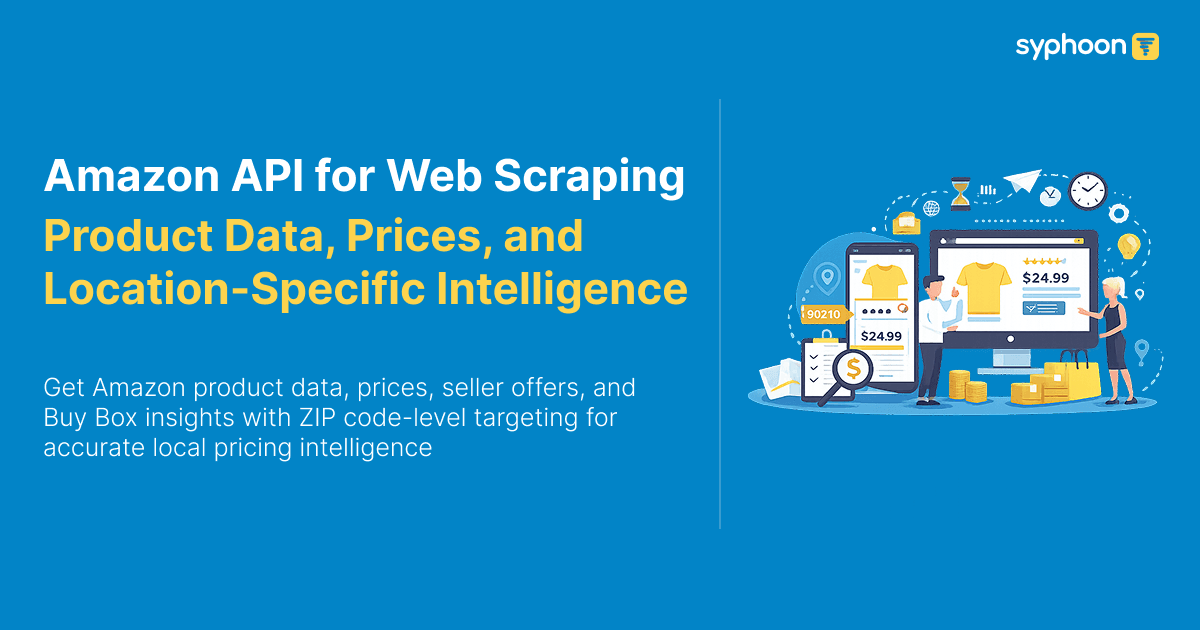
Scraping Amazon product data at scale requires more than bypassing bot detection. The more consequential problem is that Amazon does not serve uniform data. Prices, Buy Box winners, shipping costs, and promotional offers vary by delivery location, and a scraping implementation that does not account for this returns data that misrepresents what buyers in specific markets actually see. This article covers what a dedicated Amazon web scraping API provides, why ZIP code-level targeting is the operational requirement that most implementations overlook, and how Syphoon's Amazon API is structured to return accurate, location-specific product data for competitive intelligence, price monitoring, and product research at scale.
Amazon's Official API Is Not Built for Web Scraping
The first question teams ask when they need Amazon product data is whether Amazon provides an official API. It does, but the answer is more limiting than most expect.
Amazon's Product Advertising API (PA-API 5.0) has been the primary official access route for product data since 2019. As of April 30, 2026, Amazon is deprecating PA-API entirely and migrating to its Creators API. The distinction matters because PA-API was designed specifically for Amazon Associates, meaning affiliate marketers who display Amazon products on external websites to earn referral commissions. Using it for internal analytics, bulk product data scraping, or competitive intelligence violates Amazon's terms and can result in access being revoked.
Beyond the terms constraints, the rate limits make PA-API unsuitable for any serious scraping use case. New accounts receive 1 request per second and a daily cap of 8,640 requests. That limit scales upward only with referral revenue: an account requires approximately $4,600 in shipped item revenue in a trailing 30-day period to earn each additional request per second, up to a maximum of 10 requests per second. For a team that wants to monitor 50,000 ASINs daily, or track price changes across multiple geographies in real time, PA-API is architecturally the wrong tool.
Amazon's Product Advertising API is being deprecated on April 30, 2026. Teams relying on PA-API for product data access need an alternative before that date. A dedicated Amazon web scraping API is the production-grade replacement for competitive intelligence and price monitoring use cases.
The Selling Partner API (SP-API) is Amazon's other official interface, but it is restricted to sellers with a Professional selling account and provides access to a seller's own inventory, orders, and fulfillment data. It does not provide visibility into competitor pricing, product search results, or marketplace-wide availability. The Advertising API is similarly scoped to campaign management for Amazon advertisers.
The result is that for any team that needs publicly available Amazon product data at scale, for price monitoring, product research, competitive intelligence, or dropshipping analysis, a dedicated Amazon web scraping API is the appropriate solution. It accesses the same product pages any browser user can see, returns structured data without the rate and usage constraints of PA-API, and is not tied to affiliate revenue performance.
Access structured Amazon data with local pricing.
The Problem Most Amazon Scrapers Miss: Prices Are Not Uniform
Most implementations of Amazon product data scraping retrieve data from a single location, typically a US-based server in Virginia or Ohio, and treat the returned prices as representative of what Amazon buyers see. They are not.
Amazon's pricing and Buy Box logic is location-aware. The price a buyer sees for a given ASIN on Amazon.com depends on their delivery address. This is not promotional pricing or A/B testing. It is a structural characteristic of how Amazon calculates displayed prices, which incorporate shipping cost estimates, seller availability by delivery zone, and Prime eligibility by location. A product listed at $34.99 with free Prime shipping in Seattle may display a different total price for a buyer in rural Montana where the same seller does not offer Prime fulfillment. The Buy Box winner for the same ASIN may differ between ZIP codes if different sellers have different fulfilment coverage.
For competitive intelligence teams monitoring Amazon pricing, the implication is significant. A price monitoring tool that scrapes from a fixed server location in a single city returns the pricing that applies to that city. If the products being monitored are sold differently across regions because of seller distribution, Prime coverage, or zone-based shipping costs, the scraped data does not reflect the market those users actually operate in.
For e-commerce businesses benchmarking their own Amazon pricing against competitors, the same problem applies. The competitor price that is relevant is not the price in a data center in Northern Virginia. It is the price a buyer in their target market sees when they search for the product.
How ZIP code targeting resolves this
Syphoon's Amazon API accepts two location parameters that control the geographic context of every request: geocode and zipcode. When a request includes a specific US ZIP code, the API retrieves the product data, price, Buy Box winner, availability, and shipping information that Amazon returns for a buyer at that delivery location.
This means a price monitoring implementation can track the same ASIN across 10 ZIP codes simultaneously, returning the specific price and availability that applies to each market. A retailer monitoring competitor pricing in Chicago, Dallas, and Miami can confirm whether the competitor's pricing is uniform or varies by fulfilment zone. A dropshipping researcher identifying products to sell in a specific region can verify that the pricing they see reflects what buyers in that region actually pay.
What Syphoon's Amazon Web Scraping API Returns
Syphoon's Amazon API returns structured JSON for product detail pages, search results pages, and category pages. All responses are pre-parsed, meaning no HTML parsing is required on the client side. The data is ready to write to a database, import into an analytics pipeline, or push to a repricing tool.
Product detail page (by ASIN)
A request against a product ASIN returns the following fields:
| Field | Description |
|---|---|
| ASIN | Amazon Standard Identification Number, the unique product identifier |
| Title | Full product title as displayed on the product page |
| Price | Current displayed price including any promotional price where active |
| Original Price | Listed price before any discount or promotion, where available |
| Currency | Price currency tied to the Amazon marketplace domain |
| Rating | Average customer rating out of 5 |
| Review Count | Total number of customer reviews |
| Availability | In stock, out of stock, or limited availability status |
| Buy Box Seller | Seller currently winning the Buy Box for this ASIN at the requested location |
| Seller Offers | All available seller offers with individual pricing and condition |
| Images | Primary and supplementary product image URLs |
| Description | Product description text from the product page |
| Bullet Points | Key product features listed in the bullet point section |
| Specifications | Technical specifications table data where present |
| Product Variations | Available size, colour, and configuration variants with their own ASINs and prices |
| Category Path | Breadcrumb category hierarchy the product sits within |
| Best Seller Rank | BSR within primary category and subcategories where available |
| Shipping Info | Shipping options and estimated delivery times for the requested ZIP code |
| Prime Eligibility | Whether Prime shipping is available for the requested delivery location |
Search results page
A request against a search query or category URL returns a list of products from that search, each containing ASIN, title, price, rating, review count, Prime eligibility, sponsored status, and position in results. The same geocode and zipcode parameters apply, so search result pricing and Prime badges reflect the location context of the request.
Example API request
A basic request for product data by ASIN with ZIP code targeting:
1POST https://api.syphoon.com
2
3POST BODY:
4  url        : "https://www.amazon.com/dp/B0CX9BV341"
5  zipcode    : 60601          # Chicago, IL
The same request with a different ZIP code returns pricing, Buy Box winner, and shipping data specific to that delivery location. Running both requests in sequence shows whether the product has location-dependent pricing or a uniform price across markets.
Need to test Amazon data across specific ASINs and ZIP codes?
Five Use Cases for Amazon Product Data Scraping
1. Competitive price monitoring
Price monitoring is the highest-volume use case for Amazon web scraping. E-commerce businesses, brands selling on Amazon, and third-party sellers all need to know what competitors charge for comparable products in near-real time. A repricing algorithm that does not have accurate, current competitor pricing data will either leave margin on the table by pricing above a competitor who has dropped their price, or win the Buy Box at a price that is lower than necessary.
The location dimension makes this use case more complex than a single-price check. For products where multiple sellers compete and fulfillment coverage varies by region, the Buy Box winner and displayed price can differ between ZIP codes. A price monitoring implementation using Syphoon's Amazon API with ZIP code parameters can track competitor pricing across the specific markets that matter for the business, rather than a generic national average that may not reflect local competitive dynamics.
2. Product research and market validation
Before investing in inventory for a new product, sellers and brands need to understand the competitive landscape: how many sellers are competing on the target ASIN or product category, what the price range is, how BSR distributes across the category, and whether the market is dominated by a few established sellers or open to new entrants. This research requires scraping product search results and category pages at scale, not checking individual product pages manually.
Syphoon's Amazon API returns BSR, seller count, review volume, and pricing for search result sets, allowing product research workflows to process hundreds of category pages and thousands of ASINs systematically. The output feeds directly into product research tools, spreadsheet models, or custom databases without requiring HTML parsing on the client side.
3. Amazon seller intelligence for brands
Brands selling through Amazon or managing authorised seller networks use Amazon product data scraping to monitor how their products are being sold. Key questions include: Is an unauthorised seller listing on a brand's ASIN? Is the Buy Box being won by a third-party seller at a price that undercuts the brand's intended retail price? Are product images and bullet points displaying correctly across markets? Are counterfeit or grey-market listings appearing under the brand's ASINs?
Syphoon's Amazon API returns seller offer data for every ASIN, including each seller's name, price, condition, and fulfilment method. This seller offer feed is the data layer that brand protection and MAP monitoring tools require to identify unauthorised sellers and pricing violations across Amazon's marketplace systematically.
4. Dropshipping product discovery and margin analysis
Dropshipping businesses that source from Amazon need accurate, current data on product pricing, Prime eligibility, and availability before listing products on other channels. The margin calculation depends on the Amazon price at the time of purchase, which means stale pricing data leads to negative-margin orders when Amazon prices rise after a product has been listed elsewhere.
Systematic Amazon product data scraping across target categories, refreshed daily, ensures that the pricing data feeding a dropshipping operation reflects current Amazon prices. The ZIP code parameter is particularly relevant here: if the business delivers to a specific region, the Amazon price at the relevant delivery ZIP code is the correct cost basis for margin calculation, not a generic national price.
5. E-commerce analytics and pricing intelligence platforms
Companies building pricing intelligence tools, e-commerce analytics platforms, and market research products all require structured Amazon product data as a core input. These platforms need data from multiple ASINs, categories, and geographies refreshed on daily or sub-daily cadences, delivered in a format that integrates directly with their data infrastructure.
Syphoon's Amazon API is structured for this use case. Requests are stateless and accept ASIN lists or search queries, responses are pre-parsed JSON, and the API supports the geographic targeting parameters that location-aware pricing intelligence requires. For companies building Amazon data products for their own clients, Syphoon functions as the data infrastructure layer, handling the collection and structure so the product team can focus on the analytics and interface layers.
Syphoon’s Amazon API supports all five use cases with ZIP code targeting and structured JSON output. Get started with Syphoon.
How Amazon Product Data Scraping Works at Scale
A production-grade Amazon web scraping implementation requires more than a working API call. The components that determine whether a scraping pipeline delivers reliable data at volume are proxy infrastructure, anti-bot handling, parsing stability, and refresh cadence.
Proxy infrastructure and anti-bot handling
Amazon uses AWS WAF as its primary defence against automated access. The system analyses IP reputation, request headers, user agent strings, request timing, and behavioural patterns to identify non-human traffic. A naive scraping implementation using standard HTTP libraries from a fixed server IP is blocked almost immediately. Even rotating user agents without proper proxy infrastructure triggers CAPTCHA challenges within a small number of requests.
Syphoon's Amazon API handles proxy rotation, CAPTCHA resolution, and anti-bot bypass at the infrastructure level. Every request routes through residential or ISP proxy infrastructure, with the proxy tier selected based on the target page type and the detection sensitivity of the specific Amazon endpoint being accessed. The client sends a request with an ASIN and parameters and receives structured JSON in return. The proxy infrastructure, retry logic, and anti-detection handling are managed entirely on Syphoon's side.
Parsing stability
Amazon updates its front-end HTML structure frequently, including class names, element hierarchies, and the handling of dynamic content loaded via JavaScript. A scraper built against Amazon's current HTML will typically break within weeks as page structure changes. This is one of the primary reasons teams move from DIY scraping scripts to a managed Amazon web scraping API: the parser maintenance burden is transferred to the API provider.
Syphoon's Amazon API maintains parsing logic for product pages, search results, seller offers, and variation data. When Amazon updates its page structure, the parser is updated on Syphoon's side and the API continues to return the same structured JSON schema without requiring any changes to the client integration.
Refresh cadence and scheduling
The appropriate refresh cadence for Amazon product data depends on the use case. Price monitoring for an active repricing algorithm may require sub-hourly refresh on high-priority ASINs. Product research pulls are typically one-time or weekly. BSR tracking for market intelligence is often daily. Syphoon's API supports all of these cadences, with scheduled jobs available for teams that need automated periodic data collection without managing their own scheduling infrastructure.
What Amazon's PA-API Deprecation Means for Data Teams
Amazon's announcement that PA-API 5.0 will be deprecated on April 30, 2026, in favour of the Creators API has direct implications for any team currently using PA-API for product data access. The Creators API is designed for content creators in Amazon's affiliate programme and is scoped to the same use case as PA-API: displaying affiliate product links on public-facing content. It is not a replacement for bulk product data access or competitive intelligence workflows.
Teams that have built data pipelines on PA-API, even within the terms-compliant affiliate use case, will need to migrate before April 30, 2026. For those that were using PA-API in ways that fall outside its affiliate display purpose, the deprecation creates an urgent need for an alternative that is built for the actual use case: structured Amazon product data access at the volume and geographic granularity that business intelligence workflows require.
A dedicated Amazon web scraping API is that alternative. It does not require Amazon affiliate programme membership, does not limit request volume to referral revenue performance, and supports the geographic targeting, bulk ASIN processing, and structured JSON output that PA-API was never designed to provide.
Get Started with Syphoon's Amazon API
Syphoon's Amazon API returns structured product data from Amazon.com and international Amazon marketplaces, with ZIP code-level price and availability targeting any US delivery location. Responses include pricing, seller offers, Buy Box data, product variations, BSR, specifications, and shipping information, all in pre-parsed JSON with no HTML processing required on the client side.
To discuss your Amazon data requirements, request a sample output, or explore API access options, contact the Syphoon team.
Frequently Asked Questions
Join Our Community
Connect with our team, discuss your use case, ask technical questions, and share feedback with a community of people working on similar problems.