
Amazon Data Scraping Service for Enterprises: What to Look For
A buyer
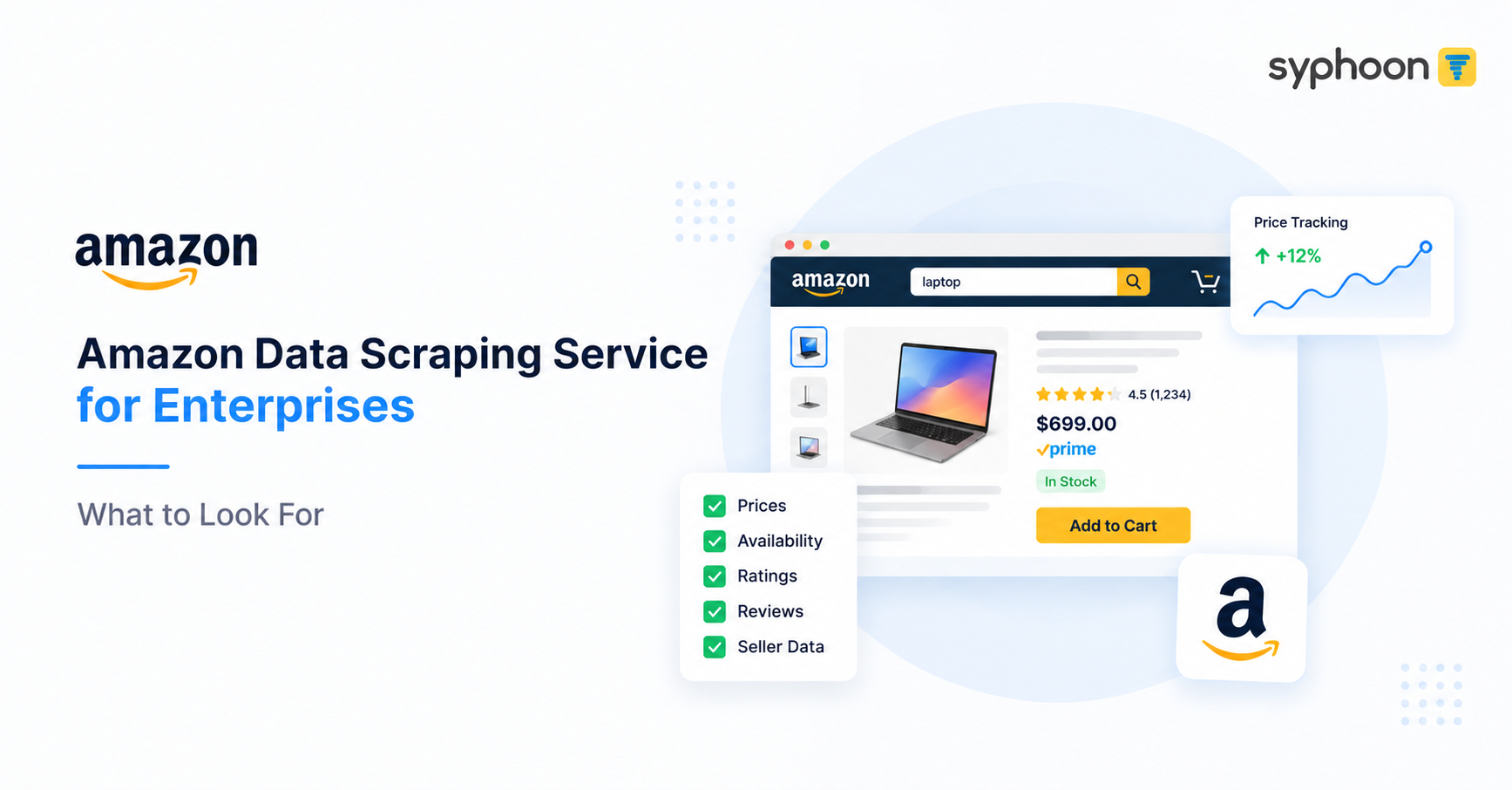
A vendor can render JavaScript, rotate proxies, solve CAPTCHAs, and hand back clean JSON, and still fail an enterprise buyer completely. At small volume, that combination is genuinely enough. At enterprise volume, thousands of ASINs are tracked daily, feeding into pricing engines or supply chain decisions; none of it matters as much as what happens when Amazon changes its page layout, what exactly counts as “uptime,” and who owns the data once the contract ends.
It's a set of questions that separate vendors who've thought about enterprise failure modes from vendors who haven't.
Uptime Alone Isn't the Right Question
Most vendor pages lead with an uptime percentage, and most enterprise buyers ask for one, because it's the easiest number to compare across a shortlist. The problem is that uptime measures whether the vendor's servers responded, not whether the data that came back was actually complete, correct, or current. A vendor can hit 99.9% uptime while quietly returning blank price fields on a rendering failure, and the uptime number won't reflect that at all.
A more defensible way to evaluate this splits the single uptime number into three separate guarantees: how many of the fields you asked for actually came back filled, how many of the values that did come back matched what was actually on the page when audited, and how old the oldest record in a delivery batch is allowed to be. One enterprise vendor-evaluation framework treats any of these three slipping below roughly 95% sustained as the trigger point for a contract review, rather than waiting for a single blended uptime figure to look bad. A vendor who can only quote you that one blended number, and can't break out completeness, accuracy, and freshness separately, likely hasn't been pushed this hard by a previous enterprise client.
The Question That Predicts Reality Better Than Uptime: Change Response
Amazon changes page structure without notice. Every scraping vendor deals with this eventually. What separates vendors isn't whether it happens, it's how fast they detect it and ship a fix. Ask directly: when a page layout change breaks extraction on a field you depend on, what's the committed response window? Same-day? Within a defined number of hours? Best-effort with no number attached? If a vendor can't give you a specific number here, ask what happened the last time it occurred and how long the fix actually took.
For a deeper dive into handling ASIN-specific changes, read our guide on how to scrape Amazon ASIN data reliably.
Reach out to discuss your custom requirements and coverage needs.
Compliance and Access Controls Enterprises Actually Ask For
Below a certain scale, nobody asks about SSO. Above it, procurement and security teams ask about little else. The baseline checklist that shows up repeatedly across enterprise vendor evaluations includes SOC 2 Type II audit status, GDPR and CCPA posture if any personal or EU-adjacent data touches the pipeline, single sign-on via SAML or OIDC rather than shared logins, SCIM for automated user provisioning and deprovisioning, and the ability to restrict API keys to specific IPs, endpoints, or output formats rather than issuing one all-access key per team. Understanding authentication requirements upfront is critical for a smooth security review.
None of this is about trusting a vendor's marketing page. It's about whether a security review can actually be completed without a six-month back-and-forth, which is often the real reason enterprise deals stall.
Delivery Format Flexibility
A vendor whose only delivery option is a CSV dropped via SFTP is telling you something about how many enterprise clients they've actually onboarded. Real enterprise integrations usually need a mix: a live API for on-demand lookups, scheduled batch drops to cloud storage for bulk refreshes, and increasingly a direct data-warehouse share so the data lands where your analysts already work instead of requiring a separate ingestion pipeline. Ask what formats are actually supported today, not on a roadmap.
Check our Amazon dedicated product page for details on supported delivery methods.
Data Validation Before It Reaches You
Raw scraped output is messy by default: duplicate ASINs from re-crawls, inconsistent formatting on price fields, partial records from a failed page load. Enterprise-grade delivery means this gets caught and cleaned before it reaches your systems, not after your team notices something's off in a dashboard three weeks later. Ask what validation happens between extraction and delivery, and ask to see an example of a record that failed validation and what happened to it.
Ready to Run a Risk-Free Enterprise Pilot?
Test Syphoon against your target ASINs, categories, and delivery specifications.
What This Looks Like Against Real Amazon Data
It helps to ground this in what a real Amazon page actually returns, since this is the kind of complexity a vendor needs to handle correctly, not just claim to handle. Here's real output from an Amazon product page:
{
  "asin": "B0FC34H632",
  "title": "LG gram Pro 17-inch Lightweight Laptop Computer...",
  "brand": "LG",
  "price": 2895.33,
  "rating": 4.0,
  "review_count": 37,
  "availability": "Only 6 left in stock - order soon",
  "best_sellers_rank": "#10,242 in Computers & Accessories"
}
And here's what showed up searching “iphone”: every single titled result in this pull, all sixteen, was listed as Renewed or Pre-Owned. Not one new-unit listing appeared:
{ "asin": "B0DHHVK432", "title": "Apple iPhone 16, 128GB, Pink - Unlocked (Renewed)", "price": 589.00, "rating": 4.1 }
{ "asin": "B08PP5MSVB", "title": "Apple iPhone 12, 64GB, Black - Unlocked (Renewed)", "price": 189.00, "rating": 4.0 }
If a brand were tracking “iPhone” competitive pricing on Amazon and assumed they were benchmarking against new-unit retail, they'd actually be comparing against a refurbished-goods market almost entirely. A vendor's extraction needs to surface the condition field explicitly and flag it, not bury “Renewed” inside a title string a downstream pricing script may or may not parse correctly.
To see how we handle these edge cases, explore our dedicated Amazon scraping solution in detail.
Observability and Who You Actually Call
When something breaks at 2 AM before a pricing run, is there a dashboard showing per-source health, or do you find out because a downstream report looks wrong? Ask whether alerting exists per data source, whether there's a named contact or on-call engineer for enterprise accounts, and whether that's distinct from a general support ticket queue. A dedicated Slack channel or named account contact is a meaningfully different support model than a shared inbox with a 48-hour SLA. Also, clarify how rate limits are communicated and managed during high-volume pulls.
Exit Clauses and Data Ownership
This gets skipped in most vendor evaluations because it's uncomfortable to negotiate before the relationship has even started. It's also the term that matters most if the relationship ends badly. Confirm in writing whether output schemas, any custom extraction configurations, and historical data archives are portable if you switch vendors. A provider using a proprietary output format or a closed extraction DSL can turn a vendor switch into a migration project measured in months rather than weeks. Knowing the response structure and status codes upfront can also help you plan for data portability.
Running an Actual Pilot
Every credible enterprise evaluation guide converges on the same recommendation: run a defined pilot, typically two to four weeks, against your actual target ASINs and categories, not a vendor's demo dataset. Compare the completeness, accuracy, and freshness numbers the pilot actually produces against what was promised in the sales conversation, line by line, before signing anything longer than the pilot itself. For transparent pricing that scales with your pilot, we offer flexible plans to match your testing needs.
Evaluating Amazon data vendors for an enterprise deployment? Run a pilot against your actual ASINs and categories, and compare the results against the framework above. Get started through our .
Frequently Asked Questions
Scale Your Web Data Collection with Syphoon
Don't let complex bot protections and proxy management slow down your business. Use Syphoon's enterprise-grade infrastructure to extract structured web data at any scale.
Written by Anton Won
@anton_intelSpecializing in distributed crawling architectures, stealth browser engines, and high-throughput proxy rotation across global e-commerce and social networks.
Related Engineering Guides
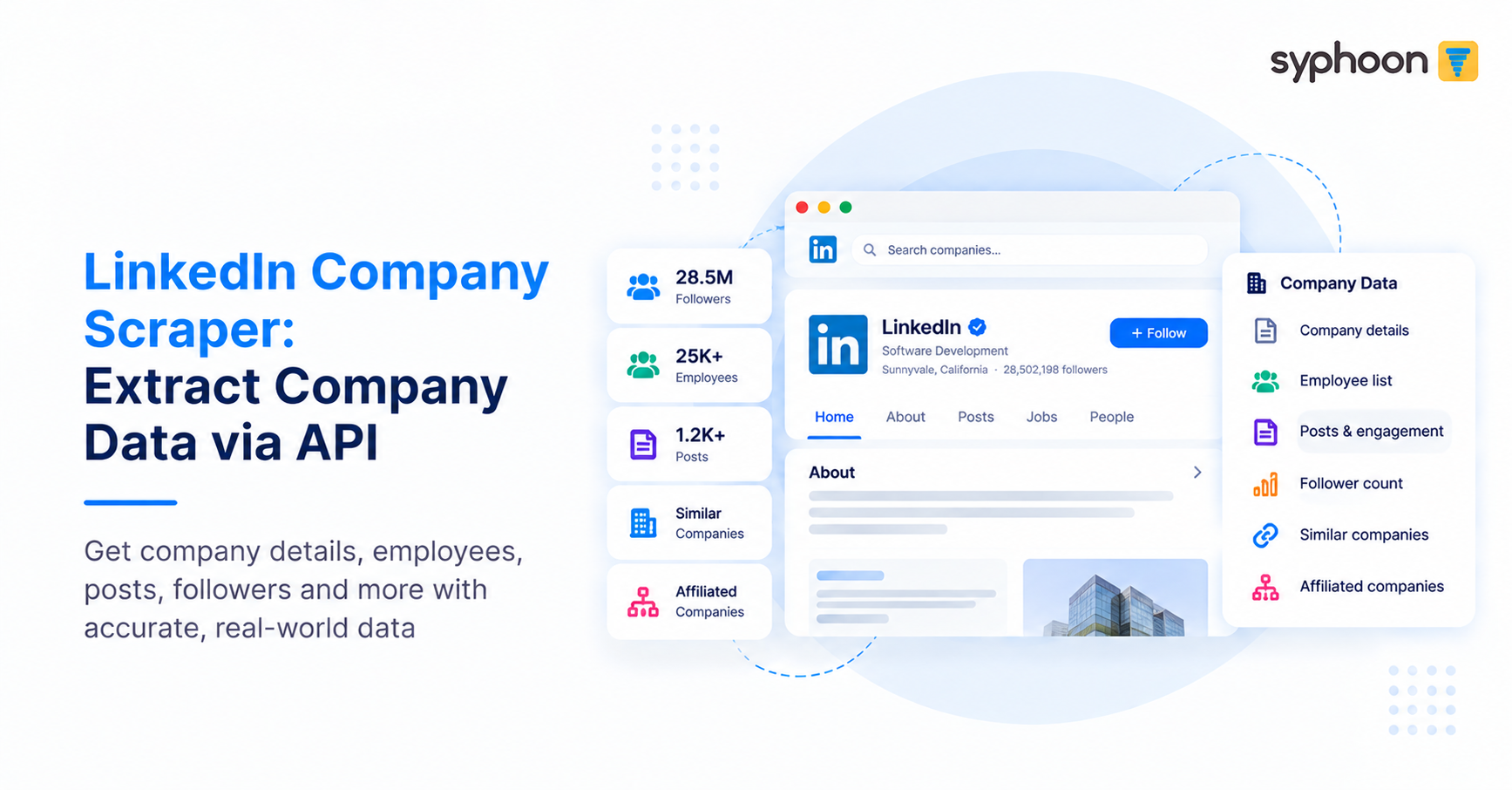
LinkedIn Company Scraper: Extract Company Data via API
Extract LinkedIn company data via API: headcount, employees, posts, similar and affiliated companies. Full field reference and real use cases.
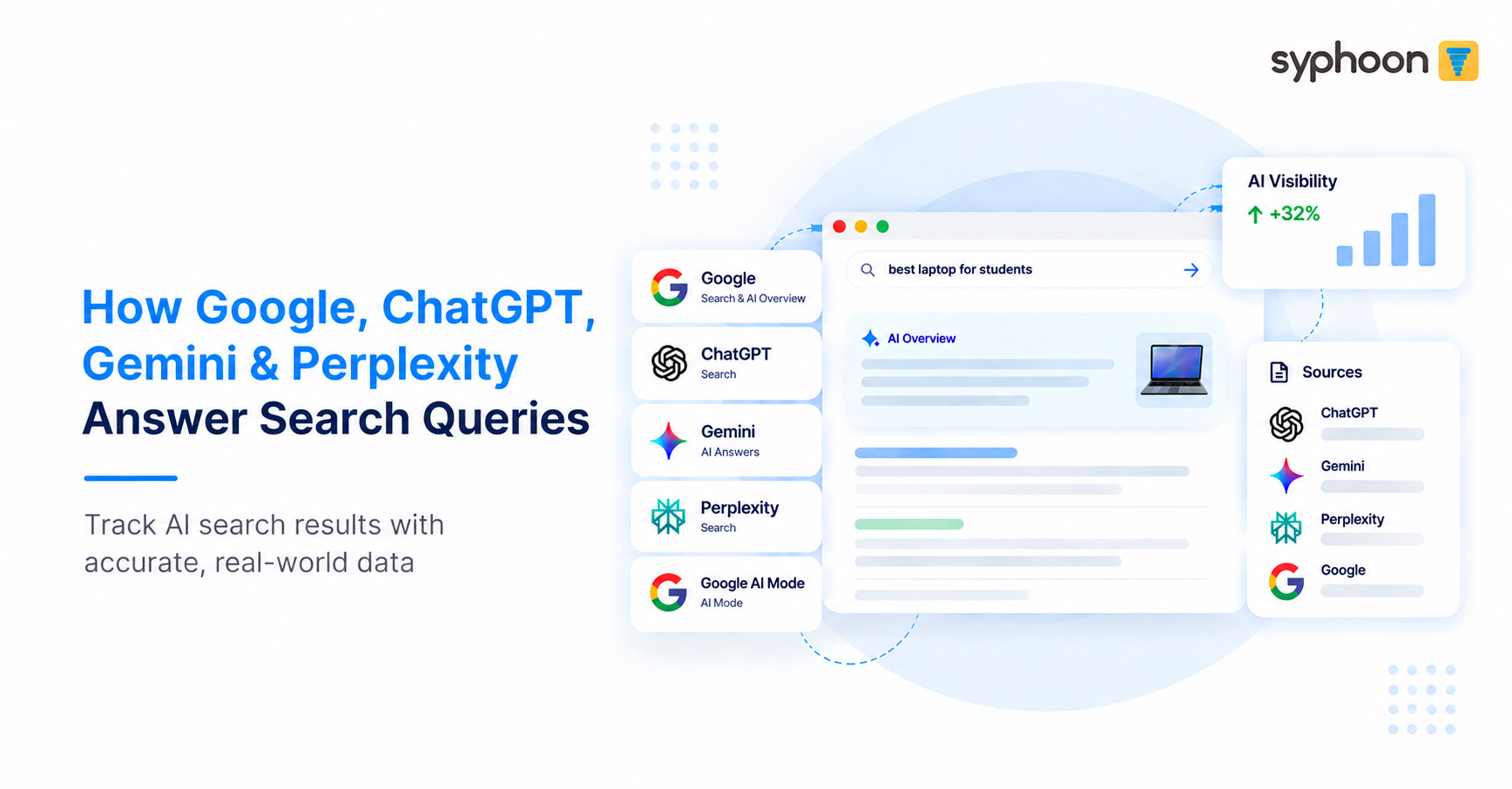
Syphoon LLM Scraper: How Google, ChatGPT, Gemini & Perplexity Answer Search Queries
Track how Google, ChatGPT, Gemini, and Perplexity actually answer search queries, including AI Overview and AI Mode. Six dedicated endpoints, one clean data layer.