If your brand sells on Blinkit or Zepto, you already know that city-level reports can lie to you and even seem off from reality. Your product might be fully stocked in Koramangala and completely absent in Whitefield. A competitor could be running a 15% flash discount in Sector 62 Noida that expires in four hours, and you won't know about it until your regional sales manager notices a volume dip three days later.
This is the structural reality of Q-commerce in India. Blinkit, Zepto, Swiggy Instamart, BigBasket BB Now, DMart Ready, and JioMart all operate on dark store networks, which are hyperlocal fulfillment centres serving specific pincodes within a 2 to 3 km radius. Each dark store carries its own inventory, applies its own promotional overlays, and promises its own delivery ETAs. What a customer sees in pincode 400001 is a completely different product landscape from what a customer sees in 400016. Same city, different data.
FMCG brands monitoring Q-commerce at city level are making pricing and assortment decisions on averaged-out data that hides the most commercially actionable signals. This guide covers why pincode-level competitor intelligence matters, what data changes by pincode, and how Syphoon's Q-commerce scraping API gives you that data programmatically across Blinkit, Zepto, Swiggy Instamart, BigBasket BB Now, DMart Ready, and JioMart.
Need to monitor Blinkit, Zepto, and Instamart at the pincode level?
Why Pincode Is the Unit of Intelligence on Q-Commerce
On Amazon, a product listed in Mumbai is available to all Mumbai buyers from the same fulfilment centre. On Blinkit, a product in Mumbai is available from one of Blinkit's 350+ dark stores, each covering a distinct cluster of pincodes. A product in stock at the Andheri dark store may be out of stock at the Bandra dark store, and absent entirely from the Powai cluster.
This creates a data problem that city-level monitoring cannot solve. The signals that actually drive commercial decisions, whether your product is on shelf, whether a competitor is discounting, or whether your delivery ETA is competitive, all vary at the pincode level, not the city level.
Three things change by pincode that change nothing at city level:
Stock availability is pincode-specific
A brand with 85% availability in Mumbai may have 0% availability in a dozen specific pincodes because a single dark store is out of stock. That out-of-stock signal is invisible in a city-level report but represents real lost revenue. On the competitor side, a brand that's chronically out of stock in your strongest pincodes is a category opportunity you can capture with a targeted promotional push, but only if you can see the gap.
Promotional pricing is pincode-specific
Blinkit, Zepto, and Instamart all apply promotional discounts at the platform level that are often time-limited and location-specific. Zepto in particular runs flash deals that expire within hours and are visible only to users in the relevant dark store's coverage zone. If you're not querying by pincode, you're not seeing these promotions. If you're not seeing them, you can't respond to them.
Delivery ETA is pincode-specific
ETA is a conversion variable, Zepto's 10-minute promise against Instamart's 15 minutes in the same search results influences which platform a buyer chooses. ETAs vary by dark store proximity and real-time order volume, both of which are pincode-dependent. Knowing where a competitor consistently delivers faster than you tells you where their dark store density is stronger, and where you should be pushing for better fulfillment coverage.
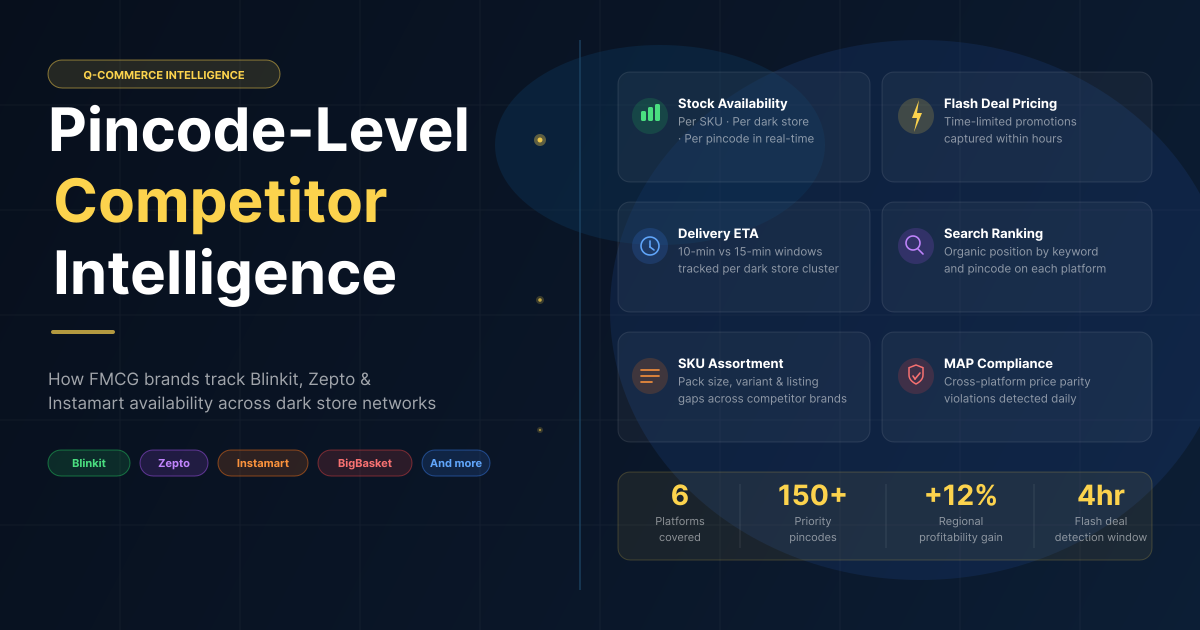
An FMCG conglomerate monitoring Blinkit and Zepto at pincode level discovered price inconsistencies between platforms in the same pincode, with competitor products priced 10 to 15% lower on one platform versus the other, and these were completely invisible in city-level reports. Acting on this data improved regional profitability by 12% in one quarter.
The Six Q-Commerce Platforms and What Data Varies on Each
| Platform | Dark Store Model | Key Data That Varies by Pincode | Primary Use Case |
|---|---|---|---|
| Blinkit | 350+ dark stores, 30+ cities | Stock availability, MRP vs. platform price, promotional overlays, search ranking | Availability monitoring, competitor pricing, assortment gaps |
| Zepto | Dense metro coverage, 10-min model | Flash discounts (time-limited, location-specific), ETA, SKU listing per store | Promotional intelligence, ETA benchmarking, flash deal tracking |
| Swiggy Instamart | 500+ cities via Swiggy ecosystem | Category deals, stock status, Swiggy One pricing, sponsored vs. organic ranking | Broad coverage intelligence, food + grocery bundling analysis |
| BigBasket BB Now | BB Now 10-min layer + slot delivery | BB Now availability vs. standard BB, pricing tiers, subscription SKU presence | Premium SKU tracking, subscription pricing intelligence |
| DMart Ready | Store-linked fulfillment, select cities | Availability tied to nearest DMart store, hyperlocal stock, pricing vs. offline | Price parity between online and offline, stock signal monitoring |
| JioMart | Kirana network + warehouse hybrid | Pincode serviceability, SKU availability, Reliance ecosystem pricing | Tier-2 and Tier-3 market intelligence, kirana overlap analysis |
For most FMCG brands in impulse categories such as snacks, beverages, personal care, and baby products, Blinkit and Zepto are the priority platforms for competitive intelligence because their dark store model creates the most granular and commercially significant pincode variation. Swiggy Instamart matters for brands with broad category presence. BigBasket BB Now, DMart Ready, and JioMart are critical for brands with strong offline distribution who need to understand how Q-commerce is disrupting their traditional channel.
What Syphoon's Q-Commerce API Returns, by Platform and Pincode
Syphoon's Q-commerce scraping API covers all six platforms (Blinkit, Zepto, Swiggy Instamart, BigBasket BB Now, DMart Ready, and JioMart) and supports both pincode-level and city-level queries. You pass a keyword, category, or product identifier along with a pincode or city parameter, and the API returns structured JSON with the following data fields:
Availability and stock status
Whether the product is listed, in stock, or out of stock at the queried location. For Blinkit and Zepto this is dark-store-level, and the stock status you receive reflects exactly what a customer placing an order at that pincode would see. Out-of-stock signals are returned explicitly, not inferred from missing data.
Price and MRP
The current selling price alongside the maximum retail price, giving you the discount percentage the platform is applying. Returns per product, per platform, per pincode, so you can compare how a competitor's product is priced across Blinkit vs. Zepto in the same pincode, or how the same product is priced in different pincodes on the same platform.
Delivery ETA
The estimated delivery time shown to a customer at that pincode at the time of query. Available for Blinkit, Zepto, and Swiggy Instamart, the three platforms where ETA is a visible competitive variable in search results. Not returned for DMart Ready and JioMart where delivery model is slot-based.
Discount and promotional pricing
Platform-applied discounts including flash deals, category promotions, and loyalty pricing (e.g. Zepto Pass discounts, Swiggy One pricing). These are time-sensitive: a flash deal on Zepto may be active for four hours. The API returns the promotional price alongside the standard price so you can identify when a competitor is running a location-specific promotion rather than a permanent price cut.
SKU-level listing data
Product title, brand, pack size, variant, image URL, and product ID. For categories where pack size strategy matters, such as beverages, snacks, and household care, seeing which SKUs a competitor has listed in a given pincode tells you their assortment strategy for that market.
Platform search ranking and position
Where a product appears in keyword search results on the platform. A brand ranked position 1 for 'protein chips' on Blinkit in Bangalore may rank position 7 in Mumbai. Tracking ranking by pincode and keyword gives you the organic visibility data to assess whether competitor ad spend or assortment decisions are shifting their search presence in specific markets.
Platform-specific note: seller and merchant information is returned for JioMart (kirana partner identity) and BigBasket BB Now (vendor/supplier data). Blinkit and Zepto operate as single-platform sellers so merchant data is not a field on those platforms.
Want to see real competitor intelligence in action?
How to Query by Pincode: the Practical Setup
Querying Syphoon's Q-commerce API by pincode follows the same pattern across all six platforms. The request takes a platform identifier, a search term or product URL, a pincode or city parameter, and your API key. The response is structured JSON.
A typical pincode-level request looks like this:
1POST https://api.syphoon.com
2
3{
4  "platform": "blinkit",
5  "keyword": "protein chips",
6  "pincode": "560001",
7  "key": "YOUR_SYPHOON_KEY",
8}
Switch the platform field to 'zepto', 'instamart', 'bigbasket', 'dmart', or 'jiomart' to query the corresponding platform. Switch pincode to a city name for city-level queries. All six platforms are accessible via the same endpoint structure. Note that multi-platform unified access under a single key is available and can be configured based on your requirement; contact Syphoon to discuss the right setup for your use case.
Scaling from One Pincode to a Monitoring Programme
The value of pincode-level data compounds when you run it systematically across a list of pincodes rather than checking one at a time. A working Q-commerce intelligence programme for an FMCG brand typically looks like this:
Step 1: Define your pincode list
Start with 50 to 150 pincodes that map to your commercial priorities, highest offline distribution overlap, strongest Q-commerce order density, and markets where your competitors are most active. For most national FMCG brands this means prioritising Mumbai, Delhi NCR, Bangalore, Hyderabad, Pune, and Chennai before expanding to Tier-2 cities.
Step 2: Define your SKU and competitor list
Identify your top 10 to 20 SKUs and the 5 to 10 competitor products you most directly compete with by category and pack size. These become the constant across your pincode queries.
Step 3: Set your query frequency
Availability and standard pricing can be monitored daily. Flash deals and promotional pricing on Zepto require higher frequency, querying every few hours during campaign periods to capture time-limited promotions before they expire. Platform search rankings can be tracked once or twice weekly unless you're running active ad campaigns.
Step 4: Build your output into a monitoring dashboard
Syphoon's API returns structured JSON that pipes directly into any BI tool, data warehouse, or custom dashboard. Most teams pipe Q-commerce data into a simple Google Sheets or Looker dashboard that shows availability by pincode on a heat map, price trends over time, and alerts for out-of-stock events or competitor promotional activity.
Teams running 50 pincodes across 3 platforms with daily availability and pricing queries are typically running 150 to 450 API calls per day. At that volume the economics of a managed API are significantly better than building and maintaining six separate scrapers, one per platform, each requiring individual maintenance every time a platform updates its frontend.
Four Use Cases Worth Building Right Now
1. Out-of-stock competitor detection
Query your top 5 competitor SKUs across your priority pincodes daily. When a competitor goes out of stock in a pincode cluster, you have a window of typically 24 to 72 hours where a targeted promotional push or sponsored placement on that platform can capture their demand. This is one of the highest-ROI plays in Q-commerce and requires nothing more than a daily availability feed by pincode.
2. Flash deal monitoring on Zepto
Zepto's flash discount system is one of the most aggressive in Indian Q-commerce, with deals that run for 4 to 8 hours, priced 15 to 25% below MRP, and applied to specific dark stores rather than the full network. Without pincode-level querying on a frequent schedule, these promotions are invisible to your pricing team until the effect shows up in your own sales data. A Zepto-specific query running every 3 to 4 hours across your target pincodes surfaces these promotions in near-real time.
3. Assortment gap identification
Query a category, say, 'protein snacks', across 50 pincodes on Blinkit. Compare which competitor SKUs appear in each pincode against which of your own SKUs appear. The gaps where competitors have presence and you don't are your supply chain and listing priority list. The gaps where you have presence and competitors don't are your promotional opportunity.
4. Price parity monitoring across platforms
Query the same SKU on Blinkit and Zepto in the same pincode. Price parity violations, where your product or a competitor's product is significantly cheaper on one platform, are a consistent source of brand equity and margin leakage. For brands with MAP policies, pincode-level cross-platform querying is the only systematic way to enforce parity in Q-commerce where traditional MAP monitoring tools have no coverage.
Getting Started with Syphoon's Q-Commerce API
Syphoon's Q-commerce scraping API covers Blinkit, Zepto, Swiggy Instamart, BigBasket BB Now, DMart Ready, and JioMart. It supports pincode-level and city-level queries and returns structured JSON across all data fields covered in this guide.
The API is currently available to clients on request, and access is set up based on the platforms and query volumes relevant to your use case. To discuss your requirements and get access:
Advanced Use Cases for Pincode-Level Intelligence
Once foundational tracking is established, FMCG brands often discover new ways to leverage hyperlocal data. Here are several advanced strategies for Q-commerce optimization:
Identifying Regional Assortment White Spaces
Competitor presence isn't uniform. A challenger brand might dominate snack categories in Mumbai but have spotty coverage in Bangalore. By scanning broad categories across the top 200 high-income pincodes, brands can map exactly where competitors are failing to secure dark store shelf space. These "white spaces" become prime targets for highly focused promotion and inventory pushing. If a competitor's flagship product drops out of stock in a specific dense cluster of pincodes, your targeted push can convert their brand-loyal customers to your product out of necessity.
Tracking Multi-Pack vs. Single-Pack Dynamics
Q-commerce consumer behavior differs from traditional large-basket grocery shopping. In many pincodes, single-serve or impulse packs move at a radically higher velocity than multi-packs. By querying stock status and search ranking across different pack sizes of the same product, FMCG companies can pinpoint which dark stores prioritize family packs and which focus on single-serve options. This allows supply chains and account managers to align their product pushes with specific demographic behavior at the pincode level. If a competitor is heavily discounting family packs in a college-heavy pincode cluster, they might be misallocating their promotional spend—an insight that lets you focus on the optimal SKUs.
Monitoring Promotional Cadence and Platform Subscriptions
Platforms often segment their user base using subscription models—like Swiggy One or Zepto Pass—which unlock specific pricing tiers. Scraping at the pincode level while simulating different account states can reveal how aggressively competitors are subsidizing these loyalty programs. Are their discounts funded by the platform, or is the FMCG brand underwriting the price cut? Observing the frequency, depth, and duration of these promotional cadences across the dark store network provides crucial intelligence for planning your own quarter-end promotional calendars. This level of granularity ensures your pricing strategy isn't merely reactive, but predictive based on historical competitor rhythms.
Also track traditional E-Commerce
While Q-commerce moves fast, traditional e-commerce remains a major volume driver. If your competitive intelligence mandate extends beyond Blinkit and Zepto, take a look at our Walmart API page and Amazon API page for structured extraction from traditional marketplaces. Alternatively, if your team prefers building scrapers in-house, Syphoon Residential Proxies (India IPs) provide the unblocked, city-precised routing required to query dark store interfaces without detection.
The Bottom Line
City-level Q-commerce data is better than nothing but not good enough for commercial decisions in a market where every dark store operates as its own inventory and pricing unit. The brands systematically winning on Blinkit and Zepto in 2026 are querying at pincode level, running their competitor and own-brand availability feeds daily, and catching promotional signals within hours rather than days.
Syphoon's Q-commerce API gives you that data across all six major Q-commerce platforms in India, structured, fresh, and queryable at the granularity that actually reflects how these platforms work.
Get Access to the Q-Commerce API.
Request access to Syphoon's Q-Commerce API for platform-specific, location-specific, and scalable data collection in a structured JSON format.
FAQs
Join Our Community
Connect with our team, discuss your use case, ask technical questions, and share feedback with a community of people working on similar problems.