How to access Naver Shopping and Search data at scale for market intelligence and e-commerce
If your market intelligence or e-commerce strategy doesn't include Naver Shopping data, you're working with an incomplete picture of one of Asia's most important retail markets. South Korea's Naver dominates e-commerce search the way Google dominates the West, and the structured product, pricing, and search data inside Naver Shopping is increasingly critical for companies expanding into or competing in the Korean market.
This guide covers exactly what Naver Shopping and Search data contains, why it's difficult to access, and how to extract it reliably at scale.
What Is Naver Shopping?
Naver is South Korea's largest technology company and its dominant search engine, holding roughly 60% of the Korean search market. Within Naver, Naver Shopping functions as the primary product discovery and price comparison platform, the equivalent of Google Shopping, but with considerably more influence over Korean consumer buying decisions.
Naver Shopping aggregates listings from Smart Stores (Naver's own merchant platform), major Korean retailers, and brand-operated storefronts. For any company monitoring the Korean retail market, Naver Shopping is not optional; it is the market.
Naver Shopping handles an enormous share of Korean e-commerce traffic. Any brand or analyst tracking Korean retail without Naver data has a fundamental blind spot.
What Data Does Naver Shopping Contain?
Naver Shopping is a remarkably data-rich platform. At the product level, a single listing can expose:
- Product metadata: full title, category hierarchy, brand, seller identity
- Pricing and discount data: list price, sale price, promotional pricing, benefit structures
- Availability and shipping: lead time, fulfilment options, stock status
- Seller and Smart Store data: store name, ratings, review counts
- Search results and ranking: which products appear for a given keyword, in what order, with what attributes
- Composite card data: the enriched product cards Naver surfaces in shopping search results, which contain aggregated price and benefit information across sellers
At the search level, Naver Shopping exposes keyword-level data: which products rank for a given query, how rankings shift over time, and how Naver's algorithm weights different attributes. This is the data that powers keyword research, SERP monitoring, and competitive intelligence specific to the Korean market.
Need structured Naver Shopping Search API data for products, pricing, and rankings?
Why Naver Shopping Data Is Hard to Access
Naver does not offer a public API for commercial data access. The platform is built to serve Korean consumers via its web and app interfaces, not to expose structured data to third parties programmatically.
This creates several practical challenges for anyone trying to collect Naver Shopping data at scale:
Anti-bot Infrastructure
Naver has sophisticated bot detection that blocks naive scraping attempts quickly. Standard HTTP requests without proper headers, session handling, and IP rotation will fail within minutes. JavaScript rendering is required for many pages, adding further complexity.
Korean-Language Interface
Naver's platform is built entirely in Korean. Parsing, structuring, and normalising data from Korean-language HTML requires specific handling that most general-purpose scraping tools don't provide out of the box.
Dynamic Page Structure
Naver Shopping's product pages and search results load dynamically. Many data points, including pricing, benefit details, and stock status, are rendered client-side, meaning static HTML fetches return incomplete data.
Pagination and Deep Results
Extracting full search result sets requires handling Naver's pagination logic, including next-page tokens that aren't always structured as simple page numbers.
The result: companies that need Naver Shopping data at scale typically face a choice between building and maintaining a complex custom scraper or finding a provider that has already solved this infrastructure problem.
Skip scraping challenges and access reliable Naver Shopping Search API data at scale.
Who Needs Naver Shopping and Search Data?
The use cases for structured Naver Shopping data span several buyer types, each with distinct requirements:
Market Intelligence and Research Teams
Analysts covering the Korean consumer market need Naver Shopping data to track pricing trends, monitor category dynamics, and understand how brands position themselves on Korea's dominant retail platform. Monthly or weekly data pulls feed into market sizing models, brand tracking reports, and competitive benchmarking.
Global Brands with Korean Operations
FMCG companies, consumer electronics brands, and apparel retailers operating in Korea use Naver Shopping data to monitor their own pricing versus competitors, track promotional compliance across distributors, and understand how their products rank for target keywords.
Cross-Border E-Commerce Platforms
Platforms expanding into the Korean market use Naver Shopping data to identify category opportunities, understand competitive pricing, and benchmark against established Korean sellers before launching.
Price Monitoring and Intelligence Tools
SaaS companies building pricing intelligence products for Korean retail need reliable, high-frequency Naver Shopping data as a core data source. Product-level price and availability data, refreshed daily or more frequently, is the backbone of these tools.
E-Commerce SEO and Keyword Research
Understanding which keywords drive volume on Naver Shopping, and how search result rankings shift over time is a distinct discipline from Google SEO. Korean agencies and brand teams use Naver Shopping search data for keyword research specific to the platform's algorithm.
Want deeper Korean market insights with Naver Datalab Shopping Insight and search data?
How to Access Naver Shopping Data at Scale
There are two practical approaches for companies that need Naver Shopping data reliably and at volume:
Option 1: Build a Custom Scraper
A custom scraper gives you full control over what you collect and when. The trade-off is significant engineering overhead: you need to handle JavaScript rendering, session management, IP rotation, Korean-language parsing, and ongoing maintenance as Naver updates its platform. For most teams, this is a poor use of engineering resources unless Naver's data collection is a core competency.
Option 2: Use a Dedicated Naver API
A Naver Scraper API abstracts all of the infrastructure complexity. You send a structured request, a product ID, a search keyword, or a product URL, and receive clean, structured JSON back - no scraper maintenance, no anti-bot headaches, no Korean HTML parsing.
This is the approach used by market intelligence firms, e-commerce analytics platforms, and data-driven brands that need Naver data as a reliable input to their pipelines, not as an engineering project in itself.
What the Syphoon Naver API Covers
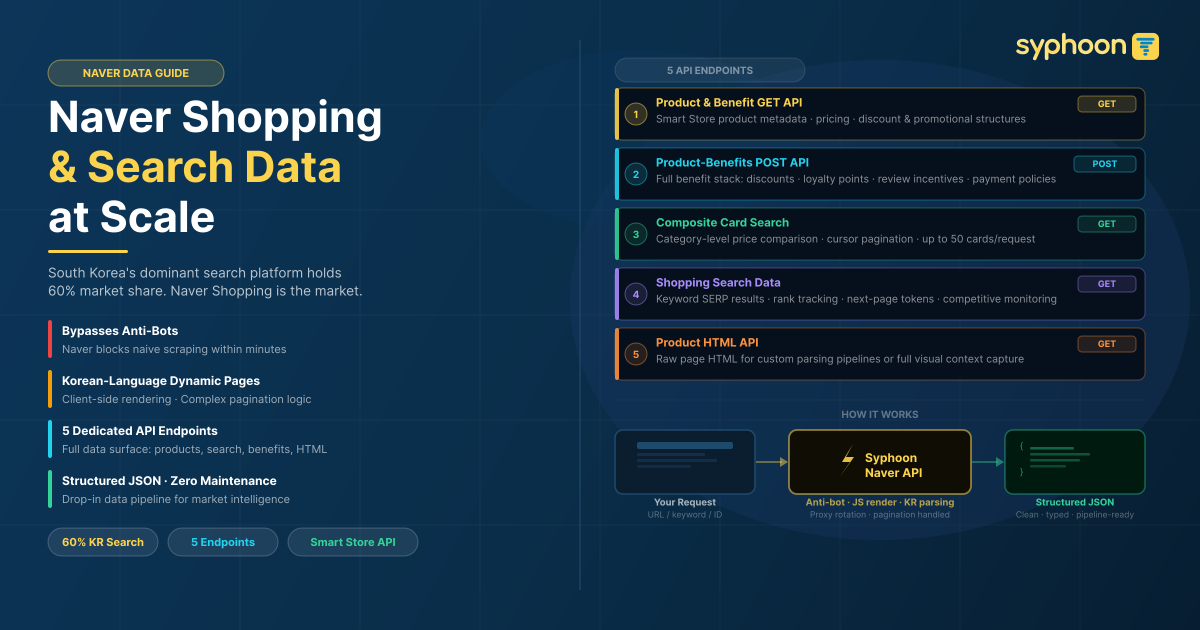
Syphoon's Naver API provides five distinct endpoints covering the full data surface of Naver Shopping, each designed for a specific data extraction need:
1. Naver Product and Benefit GET API
Retrieves live product and benefit data directly from Naver's Smart Store API. The endpoint requires two parameters: the internal Naver API URL (the Smart Store products or benefits endpoint for the specific channel and product) and the corresponding public product URL. It returns a JSON object with two keys, data (the full Naver API response) and status_code_returned, covering product metadata, benefit details, discount and promotional pricing, and category-level attributes. This is the primary endpoint for product-level price monitoring and competitor analysis on individual Smart Store SKUs.
2. Naver Product-Benefits POST API
A POST proxy for Naver's own product-benefit endpoint. Unlike the GET API, this endpoint passes a full naver_body payload, a structured object containing the product's benefit calculations, including discounted sale price, seller's immediate discount amount and ratio, purchase points, text and photo review points, paymoney and bankbook accumulation policies with percentage rates and caps, category hierarchy, and channel data. It returns the same JSON structure (data + status_code_returned) as the GET endpoint. Use this when you need to recalculate or verify the full benefit stack for a product, discount rates, loyalty points, review incentives, against Naver's pricing engine directly.
3. Naver Composite Card Search
Retrieves paged composite card data from Naver Shopping search results. Notably, the query parameter accepts a category ID (e.g. 10007104) rather than just keyword text, meaning you can pull composite cards for an entire product category, not just a specific search query. Supports cursor-based pagination and configurable page sizes up to 50 cards per request, with filter flags for secondhand, rental, and overseas listings. Each composite card aggregates pricing and benefit information across multiple sellers for the same product, showing how Naver presents competitive pricing at the search result level. This is particularly valuable for category-level price monitoring and understanding how Naver ranks and displays competing sellers for a given product type.
4. Naver Shopping Search Data
Fetches shopping search results from Naver for a given keyword, including paginated results and next-page data. This is the core endpoint for SERP monitoring, keyword research, and tracking how product rankings shift over time for specific search terms.
5. Naver Shopping Product HTML API
Returns the raw HTML of a Naver Shopping product page for cases where teams need full page content rather than pre-parsed structured data, useful for custom parsing pipelines or when capturing the full visual context of a product listing matters.
Together, these five endpoints cover product-level data, search-level data, benefit and pricing structures, and raw HTML, giving teams a complete data extraction layer for Naver Shopping without building or maintaining any scraping infrastructure.
What You Can Build With Naver Shopping Data
With reliable access to structured Naver Shopping and Search data, teams across market intelligence, e-commerce, and data products can build:
- Smart Store product and benefit monitoring tools that track pricing and promotional changes across Korean sellers in real time
- SERP tracking systems that monitor keyword ranking positions on Naver Shopping over time
- Market intelligence dashboards showing category-level pricing trends, brand presence, and competitive dynamics in the Korean market
- E-commerce pricing and benefit comparison tools for brands managing pricing across Korean distribution channels
- Advanced keyword research tools calibrated specifically to Naver Shopping's algorithm and Korean consumer search behaviour
Getting Started
Syphoon's Naver API is available as part of the dedicated APIs suite alongside Amazon, Walmart, Shopee, and TikTok Shop. Full documentation covering all five Naver endpoints, including request parameters, response schemas, and code examples, is available at:
syphoon.com/dedicated/naverFor teams that need to evaluate the data before committing, sample data is available on request.
The Bottom Line
Naver Shopping is the primary product discovery platform in one of Asia's most important e-commerce markets. The data it contains—product metadata, pricing and benefit structures, search rankings, and seller information—is essential for any serious market intelligence or e-commerce operation covering Korea.
Accessing that data reliably at scale is genuinely difficult to do with a custom scraper. A dedicated API that handles the infrastructure complexity, JavaScript rendering, anti-bot handling, Korean-language parsing, and pagination lets teams focus on what they actually need: the data and what it tells them.
Syphoon's Naver API covers the full data surface of Naver Shopping across five endpoints, delivering structured JSON that drops directly into existing analytics and data pipelines.
Scale Your Web Data Collection with Syphoon
Don't let complex bot protections and proxy management slow down your business. Use Syphoon's enterprise-grade infrastructure to extract structured web data at any scale.
FAQs
Join Our Community
Connect with our team, discuss your use case, ask technical questions, and share feedback with a community of people working on similar problems.