What Is a Residential Proxy?
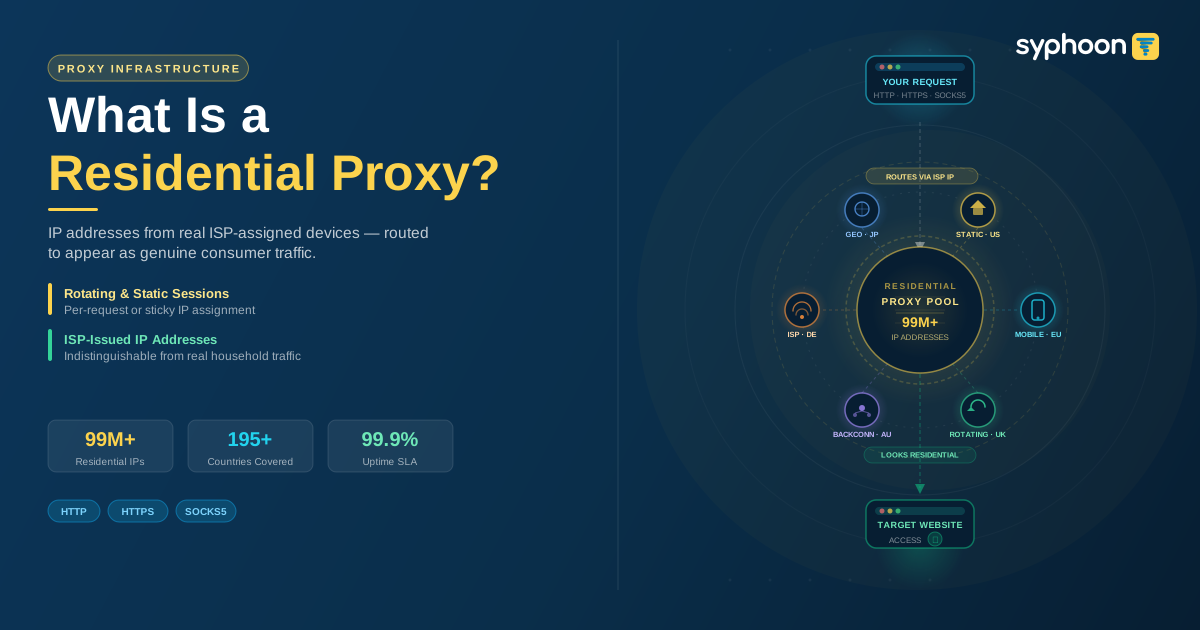
A residential proxy is an intermediary server that routes internet traffic through an IP address assigned by an Internet Service Provider (ISP) to a real residential device.
Because these IP addresses originate from legitimate household connections, requests sent through residential proxies appear as regular user traffic. This makes them fundamentally different from datacenter proxies, which rely on cloud-hosted IP ranges that are often easily identifiable.
In modern web environments where platforms actively monitor IP reputation, this distinction is critical.
How Residential Proxies Work
When a request is sent through a residential proxy network, the traffic is routed via an ISP-issued IP address associated with a real-world geographic location. The target website processes the request as if it originated from a consumer browsing the internet.
Behind the scenes, residential proxy networks maintain pools of residential IP addresses. A client connects to the proxy provider, which assigns an available IP from the pool. The request is forwarded, the response is received, and the data is returned to the client system.
At scale, this process requires orchestration mechanisms such as automatic IP rotation, session management, and usage balancing to prevent overuse of individual addresses.
Need Help Understanding How to Use Residential Proxy Networks at Scale?
Types of Residential Proxies
Residential proxies are typically offered in several configurations depending on rotation behavior, IP persistence, and network origin. Understanding these distinctions is important when designing reliable web data infrastructure.
Rotating Residential Proxies
Rotating residential proxies automatically assign a new residential IP address either for every request or after a defined time interval. In most implementations, rotation can occur:
- Per request (new IP for each connection)
- Per session (IP changes after a specified duration)
This rotation reduces the likelihood of detection in environments where repeated requests from a single IP address may trigger restrictions. Rotating proxies are commonly used for:
- Large-scale web scraping
- Search engine results monitoring
- Price aggregation
- Ad verification
- Marketplace data collection
They are particularly useful when interacting with high-protection websites that evaluate IP behavior patterns.
Static (Sticky) Residential Proxies
Static residential proxies — often referred to as sticky sessions — assign a single residential IP address to a client for an extended duration. Unlike rotating proxies, the IP does not change automatically with every request. Instead, the connection remains consistent for a defined session window.
This configuration is useful when:
- Session persistence is required
- Login-based workflows are involved
- Multi-step browsing flows must remain stable
- Account creation or validation processes require continuity
Static residential proxies provide greater session stability but offer less traffic diversity compared to rotating pools.
ISP Proxies (Residential on Datacenter Infrastructure)
ISP proxies represent a hybrid model between residential and datacenter proxies. They are hosted on datacenter servers but use IP addresses registered under Internet Service Providers. Because the IP addresses are ISP-issued, they appear as residential in reputation databases, even though the infrastructure is hosted in controlled server environments.
This configuration typically offers:
- Higher stability and speed than traditional residential networks
- Longer IP retention
- Lower variability in connection quality
However, ISP proxies do not provide the same IP diversity as rotating residential pools. They are often used when session stability is important but full residential rotation is unnecessary.
Mobile Residential Proxies
Mobile residential proxies route traffic through IP addresses assigned by mobile carriers rather than fixed broadband ISPs. These IP addresses originate from devices connected to cellular networks such as 3G, 4G, or 5G.
Mobile IPs often operate behind carrier-grade NAT systems, meaning many users share a smaller pool of IP addresses. Because of this structure, mobile IP ranges typically carry extremely high trust levels and are less frequently blocked.
Mobile residential proxies are relevant in environments where:
- Both datacenter and broadband residential IPs face aggressive blocking
- High-trust IP reputation is required
- Geo-specific mobile traffic simulation is necessary
They tend to be more expensive and may exhibit variable performance due to the nature of cellular networks. As a result, they are generally used selectively in high-sensitivity scenarios rather than as default infrastructure.
Backconnect Gateway Model
Many residential proxy networks operate through a backconnect gateway system.
Instead of manually selecting individual IP addresses, the client connects to a single proxy endpoint. The provider manages IP assignment and rotation behind that gateway. This simplifies integration and allows dynamic allocation from large IP pools without requiring direct management of individual addresses.
In enterprise environments, this model reduces configuration complexity while preserving flexibility.
Residential vs Datacenter Proxies
The primary difference between residential and datacenter proxies lies in IP origin.
Datacenter proxies use IP addresses generated by cloud hosting providers. These IP ranges are often publicly known and can be identified as non-consumer traffic. They typically offer faster speeds and lower cost, but are more likely to be blocked on protected websites.
Residential proxies use ISP-issued IP addresses associated with real devices. Because these addresses resemble standard consumer traffic, they are generally more trusted by default.
In high-protection environments such as e-commerce platforms, ticketing systems, travel booking sites, and marketplace ecosystems, residential proxies often achieve higher request success rates.
Looking for High-Trust Residential Proxies for Reliable Data Collection?
Residential Proxies vs ISP Proxies
ISP proxies represent a hybrid model. They are hosted on datacenter infrastructure but registered under ISP-issued IP ranges.
While they offer greater stability and speed compared to traditional residential networks, they do not provide the same level of traffic diversity as rotating residential pools.
Understanding these distinctions helps determine which proxy type aligns best with specific use cases.
Supported Protocols
Residential proxies typically support HTTP, HTTPS, and SOCKS5 protocols.
HTTP and HTTPS proxies are commonly used for web traffic and API requests. SOCKS5 proxies operate at a lower networking layer and support a wider range of traffic types.
Protocol selection depends on the technical requirements of the application and the type of data being accessed.
Common Use Cases for Residential Proxies
Residential proxies are frequently used in scenarios where IP reputation and geo-location matter. These include:
- Search engine results monitoring
- Ad verification
- Competitive price aggregation
- Brand protection monitoring
- Travel fare comparison
- Marketplace data collection
They are particularly relevant when websites apply geo-based content variation or aggressive anti-bot measures.
However, residential proxies are not universally required. In lower-protection environments, datacenter proxies may offer sufficient reliability at reduced cost.
Geo-Targeting Capabilities
One of the defining advantages of residential proxies is precise geo-targeting.
Because residential IPs are tied to physical locations, proxy providers can route traffic through specific countries, states, or cities. This enables accurate access to localized pricing, inventory availability, and region-specific content variations.
For organizations operating across markets, geo-targeted access is often a core requirement.
Legal and Ethical Considerations
Residential proxies are legal tools. Their legitimacy depends on responsible sourcing and compliant use.
Reputable providers operate opt-in networks where participants consent to share bandwidth. Transparency in IP sourcing is essential. Organizations using residential proxies must also ensure that their data collection practices comply with relevant regulations and platform terms.
The ethical dimension lies not in the proxy itself, but in how it is deployed.
Limitations and Operational Considerations
Residential proxies involve trade-offs.
They are typically more expensive than datacenter proxies. Network performance may vary depending on the underlying consumer connection. Improper rotation logic can lead to rapid IP exhaustion or detection.
At enterprise scale, proxy management requires monitoring, load balancing, cost control, and failure handling. Residential proxies function most effectively when integrated into broader data extraction infrastructure rather than used as standalone tools.
Syphoon embeds residential proxy orchestration within full-scale web data systems, allowing organizations to abstract proxy complexity while maintaining stable access to protected environments.
Have Questions About Residential Proxies for Your Use Case?
Residential Proxies in Modern Web Data Infrastructure
In early-stage scraping projects, proxies are often treated as configuration details. In mature systems, they become architectural components.
Sustainable web data operations depend on coordinated infrastructure — including proxy rotation, session control, rendering for JavaScript-heavy platforms, structured data normalization, and monitoring systems.
Residential proxies play a critical role in environments where detection resistance and geographic accuracy are required. They are not bypass tools. They are infrastructure elements within a larger data strategy.
Scale Your Data Extraction with Syphoon Residential Proxies
Access web data globally using high-trust residential IPs designed for reliable data collection across regions and platforms.
Frequently Asked Questions
Join Our Community
Connect with our team, discuss your use case, ask technical questions, and share feedback with a community of people working on similar problems.