TikTok Shop has grown into one of the most commercially significant e-commerce platforms on the internet. In the US, TikTok Shop reached $9 billion in GMV in 2024 and has consistently exceeded $1 billion in monthly sales since mid-2024. For brands, analysts, and developers building competitive intelligence tools, that means one thing: TikTok Shop data is no longer optional.
The problem is that TikTok does not offer a public API for commercial product data access. Scraping TikTok Shop manually is technically demanding as the platform uses aggressive anti-bot detection, JavaScript-heavy rendering, and region-specific content that requires authentic local IPs. Building and maintaining a TikTok Shop scraper in-house is a significant engineering commitment that breaks every time TikTok updates its infrastructure.
This guide covers what TikTok Shop data is available, why extracting it is technically difficult, and how a dedicated TikTok Shop scraper API solves the infrastructure problem so your team can focus on the data rather than the plumbing.
What Is TikTok Shop and Why Does Its Data Matter?
TikTok Shop is TikTok's integrated e-commerce platform, launched in the US in September 2023 and already operating across the UK, Southeast Asia, and other markets. Unlike traditional eCommerce marketplaces, where users navigate to buy, TikTok Shop is embedded directly into the content feed, and products appear in videos, live streams, and a dedicated shopping tab.
This creates a data landscape that is fundamentally different from Amazon or Walmart. Product discovery on TikTok Shop is keyword and trend-driven. What ranks at position one for a keyword this week may not rank next week. Pricing, seller performance, and product availability shift rapidly in response to viral content rather than just algorithmic optimisation.
For anyone building e-commerce intelligence tools, monitoring competitor products, or tracking trends for brand clients, this data has significant commercial value:
- Brands selling on TikTok Shop need to know what competitors are pricing at and which keywords their products rank for
- Market intelligence firms need trend data from TikTok Shop to complement their Amazon and Walmart coverage
- Creator economy platforms need real-time product data to match creators with the right affiliate products
- Price monitoring SaaS companies are adding TikTok Shop as a data source as their clients demand it
Need real-time TikTok Shop product and seller insights?
Why TikTok Shop Data Scraping Is Technically Difficult
TikTok Shop presents a more complex scraping challenge than most e-commerce platforms. Several factors combine to make naive scraping approaches fail quickly.
Anti-Bot Infrastructure
TikTok runs sophisticated bot detection across all of its web properties. Standard HTTP requests without proper headers, browser fingerprinting simulation, and IP rotation are blocked almost immediately. TikTok's detection looks at request headers, timing patterns, user-agent strings, and IP reputation simultaneously; a single missing signal can trigger a block.
JavaScript Rendering
TikTok Shop pages are heavily JavaScript-rendered. A static HTTP request to a TikTok Shop product page returns minimal useful data, the actual product information, pricing, seller details, and availability are loaded dynamically. This means a working scraper requires headless browser automation or a proxy solution that handles JS rendering natively.
Region-Specific Content
TikTok Shop operates as distinct regional markets. A product URL from the Malaysian market (region: my) will return completely different data from a US market URL. Pricing, availability, seller information, and even product catalogues differ by region. Scraping TikTok Shop without region-aware IP routing returns incorrect or incomplete data.
Proxy Requirements
Even with proper browser fingerprinting, TikTok Shop blocks IPs that don't match the expected traffic profile for the region being scraped. Datacenter proxies are detected quickly. Residential proxies improve success rates but add cost and latency. The proxy layer for TikTok scraping needs to be matched to the target region, US content requires US residential IPs, Malaysian content requires Malaysian IPs.
The result: teams that try to build a TikTok Shop scraper in-house typically spend several weeks on infrastructure, achieve inconsistent success rates, and face ongoing maintenance every time TikTok updates its anti-bot layer.
What Data You Can Extract from TikTok Shop
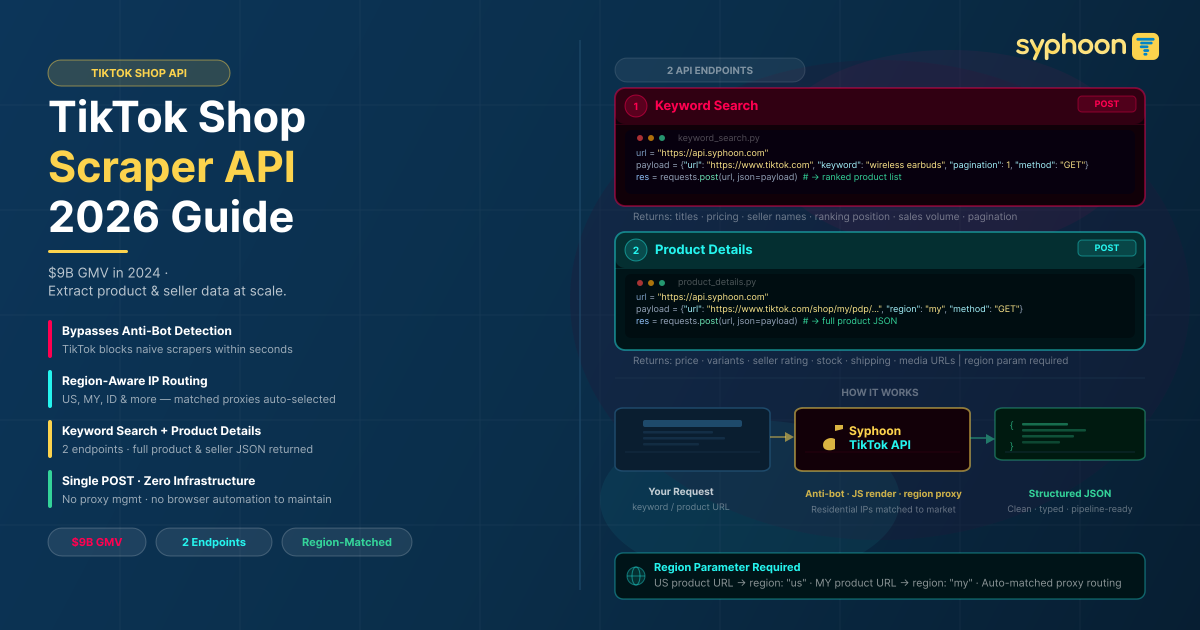
A properly built TikTok Shop scraper API exposes two primary data surfaces:
1. Keyword Search Results
By passing a keyword query, you retrieve TikTok Shop's search results for that term, the full list of products that appear when a user searches for that keyword. This includes:
- Product titles and IDs
- Pricing and promotional pricing
- Seller names and seller metrics
- Product thumbnails and media
- Sales volume indicators
- Search result ranking position
Pagination is supported via an integer page parameter, allowing you to retrieve deep result sets across multiple pages for any keyword.
2. Product Details
By passing a specific TikTok Shop product URL along with the target region, you retrieve the full product detail data for that listing:
- Complete product title and description
- Current price and any promotional or sale pricing
- Seller identity and seller rating
- Product variants (size, colour, etc.)
- Availability and stock status
- Shipping information and estimated delivery
- Product images and media URLs
The region parameter is critical here. TikTok Shop product URLs are region-specific; a Malaysian product URL (containing /shop/my/) requires the region set to 'my' to return accurate local pricing and availability data.
Looking for scalable TikTok product scraping without managing infrastructure?
How Syphoon's TikTok Shop Scraper API Works
Syphoon's TikTok Shop API provides two dedicated endpoints that handle all of the infrastructure complexity described above, anti-bot bypass, JS rendering, region-aware IP routing, and return clean JSON from TikTok's own API. You send a structured POST request and receive structured product data back.
Both endpoints use the same base URL: https://api.syphoon.com
Endpoint 1: TikTok Shop Keyword Search
Use this endpoint to retrieve TikTok Shop search results for any keyword. The request requires four parameters:
- Url: always set to https://www.tiktok.com for keyword search
- Keyword: the search term you want results for
- Key: your Syphoon API key from the dashboard
- Method: always set to GET for this endpoint
- Pagination: integer page number to retrieve subsequent result pages
Python example:
1import requests, json
2
3url = "https://api.syphoon.com"
4
5payload = json.dumps({
6    "url": "https://www.tiktok.com",
7    "keyword": "wireless earbuds",
8    "pagination": 1,
9    "key": "YOUR_SYPHOON_KEY",
10    "method": "GET"
11})
12
13response = requests.post(url, headers={"Content-Type": "application/json"}, data=payload)
14print(response.json())
The response returns raw JSON data directly from TikTok's API, the same structured data that powers TikTok Shop's own search results interface. Increment the pagination parameter to retrieve subsequent pages of results for the same keyword.
Endpoint 2: TikTok Shop Product Details
Use this endpoint to retrieve complete product data for a specific TikTok Shop listing. The request requires four parameters:
- Url: the full TikTok Shop product URL for the listing
- Region: the two-letter region code matching the product URL's market (e.g. 'my' for Malaysia, 'us' for United States)
- key: your Syphoon API key
- method: always set to GET
Python example:
1import requests, json
2
3url = "https://api.syphoon.com"
4
5payload = json.dumps({
6    "url": "https://www.tiktok.com/shop/my/pdp/1730225607774799603",
7    "region": "my",
8    "key": "YOUR_SYPHOON_KEY",
9    "method": "GET"
10})
11
12response = requests.post(url,
13    headers={"Content-Type": "application/json", "Accept": "*/*", "Connection": "keep-alive"},
14    data=payload)
15print(response.json())
The region parameter must match the market of the product URL. A Malaysian product URL (containing /shop/my/) requires a region set to 'my'. Mismatched region parameters will return incorrect or empty data.
Want to integrate a reliable TikTok Scraper API into your workflow?
The Role of Proxies in TikTok Shop Scraping
Proxies are the infrastructure layer that makes reliable TikTok Shop data extraction possible. When you send a request to TikTok Shop, the platform assesses the IP address, request headers, and traffic patterns to determine whether the request comes from a real user or an automated scraper.
Why Standard Proxies Fail on TikTok
Datacenter proxies, IP addresses assigned to commercial server farms rather than real devices, are detected and blocked by TikTok's bot detection almost immediately. TikTok checks the ASN (Autonomous System Number) of each incoming IP to determine whether it belongs to a data centre or a residential ISP. Datacenter IPs fail this check.
Residential proxies perform significantly better because they carry real ISP registrations and appear as genuine household devices. However, not all residential proxies are equal; proxies that have been burned by previous scraping activity, or that route traffic in unnatural patterns, still trigger detection.
Region-Matched Proxies
For TikTok Shop scraping specifically, proxy selection needs to be region-aware. To scrape TikTok Shop US, your requests need to originate from US residential IPs. To scrape TikTok Shop Malaysia, you need Malaysian IPs. Routing a Malaysian product URL through a US IP returns geographically incorrect pricing and availability data, regardless of whether the scraper itself is working correctly.
Syphoon's TikTok Shop API handles proxy selection and region matching automatically. When you pass a product URL with the region parameter, the API routes the request through the appropriate regional IP pool without any additional configuration on your end.
The proxy layer is the most common point of failure for teams building TikTok Shop scrapers in-house. Syphoon's dedicated API abstracts this entirely, you pass the region parameter and the correct regional IP routing happens automatically.
Have questions about TikTok Shop scraping or API integration?
TikTok Shop API Alternatives - Build vs Buy
When your team needs TikTok Shop data, there are three realistic approaches:
Option 1: Build a Custom Scraper
Building in-house gives you full control but requires significant engineering investment. A production-grade TikTok Shop scraper needs: headless browser automation (Playwright or Puppeteer), proxy rotation with region-matching, CAPTCHA and anti-bot bypass logic, session management, error handling and retry logic, and ongoing maintenance.
Option 2: Use an Open-Source Scraper
Open-source TikTok scrapers exist on GitHub and platforms like Apify. These are typically maintained by individuals or small teams and are not designed for production-scale reliability. They work until they don't.
Option 3: Use a Dedicated TikTok Shop Scraper API
A managed scraper API handles all infrastructure complexity and returns clean data via a single POST request. No proxy management, no anti-bot maintenance, no browser automation to maintain.
Syphoon's TikTok Shop API is currently live for the US market, with support for additional regions available on request. Full documentation is at syphoon.com/dedicated/tiktok
What You Can Build With TikTok Shop Data
With reliable access to structured TikTok Shop product and seller data, teams across e-commerce intelligence, brand analytics, and creator economy platforms can build:
- Product trend monitoring dashboards: track which products are rising in search rankings by keyword
- Competitor price monitoring: monitor competitor product pricing and promotional pricing in real time
- Creator-product matching tools: identify high-performing products for affiliate platforms
- Brand performance analytics: track a brand's product search rankings, pricing, and seller metrics
- Market entry research tools: analyse what products dominate a category before launching
- E-commerce data pipelines: feed structured data into existing analytics stacks alongside Amazon, Walmart, and Shopee data
Getting Started with the Syphoon TikTok Shop API
Syphoon's TikTok Shop API is available as part of the dedicated APIs suite alongside Amazon, Walmart, Shopee, Naver, and Lazada. Both endpoints are live for the US market. Regional support for additional TikTok Shop markets is available on request.
Full documentation including all request parameters, response schemas, and code examples is available at: syphoon.com/dedicated/tiktok
To evaluate the API before committing, a free trial is available directly from the dashboard.
The Bottom Line
TikTok Shop is a fast-moving e-commerce platform where product rankings, pricing, and seller performance shift rapidly. The data it contains is commercially valuable and structurally difficult to collect at scale without the right infrastructure.
Building a production-grade TikTok Shop scraper in-house requires significant engineering investment. A dedicated TikTok Shop scraper API abstracts all of that complexity and delivers clean, structured JSON via a single POST request.
For teams that need TikTok Shop product and seller data reliably and at scale, Syphoon's dedicated TikTok Shop API covers keyword search and product details with region-aware data delivery and no scraping infrastructure to maintain.
Scale Your Web Data Collection with Syphoon
Don't let complex bot protections and proxy management slow down your business. Use Syphoon's enterprise-grade infrastructure to extract structured web data at any scale.
FAQs
Join Our Community
Connect with our team, discuss your use case, ask technical questions, and share feedback with a community of people working on similar problems.