Non-Technical Summary
If you just want the short version: Syphoon reads Expedia's own internal data layer directly (the same structured data Expedia's website itself is built from) rather than rendering a page and scraping visible text off it. That means fewer broken fields when Expedia redesigns a page, typed numbers instead of strings like “$180 per night,” and full room, discount, and nearby-places data most competitors don't return at all.
On pricing: five of the six options here bill in “credits,” a unit that doesn't map 1:1 to a request and makes your actual bill hard to predict in advance. Syphoon bills per request. What you send is what you're charged for, nothing translated through a credit multiplier you have to look up in a separate table.
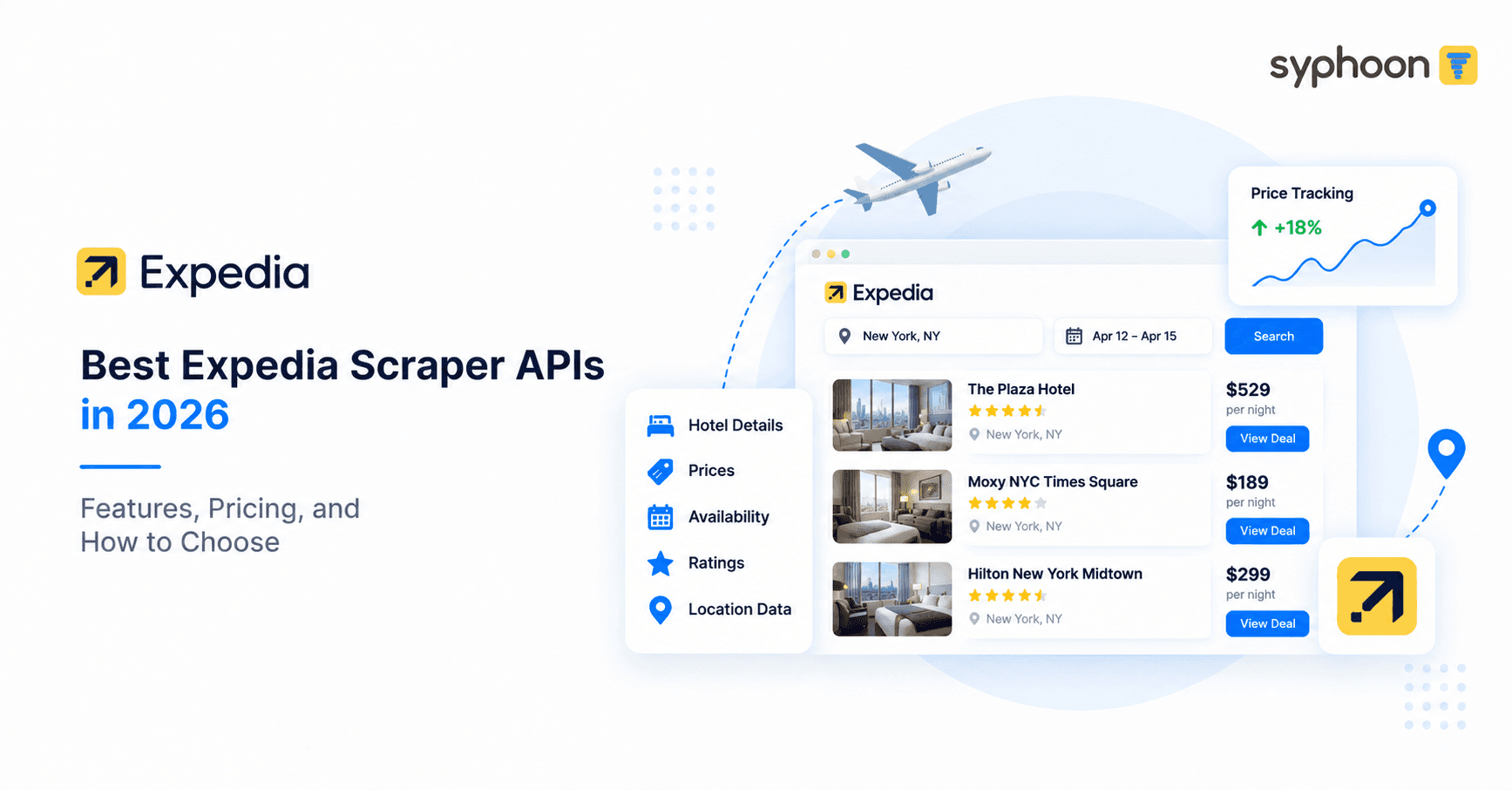
Six tools show up consistently when engineering and data teams search for a way to extract hotel and travel data off Expedia at scale: ScraperAPI, Crawlbase, Bright Data, ScrapingBee, an Apify community actor, and Syphoon.
We analyzed the actual product documentation, response schemas, extraction mechanisms, and billing structures for all six rather than relying on marketing copy. The differences go far deeper than proxy pool size—they determine whether your data arrives as typed numbers ready for downstream databases or fragile text blobs requiring continuous parser maintenance.
Quick Comparison
Here is a summary comparison of how the leading Expedia scraping providers compare on extraction architecture, output quality, and billing units:
| Provider | Extraction method | Data output type | Pricing model | Best for |
|---|---|---|---|---|
| Syphoon | GraphQL data layer | Structured JSON (typed numbers, rooms & discounts) | Per request (volume-based) | Teams needing reliable, pre-parsed hotel search & room data |
| ScraperAPI | Rendered HTML / Markdown | Raw HTML or unstructured markdown text | Credits with JS multipliers | General-purpose web scraping across mixed sites |
| Crawlbase | Rendered HTML or generic extractor | Generic page metadata blob (title, description) | Credit-based monthly plans | Teams with existing in-house parsers for raw HTML |
| Bright Data | Managed browser & Web Unlocker | Flight fields (price, airline, stops) | Pay-per-success / Bandwidth | Enterprise flight tracking and broad web proxying |
| ScrapingBee | Headless browser + CSS selectors | Unstructured strings (e.g., '$180 per night') | Credit-based with JS rendering costs | Small projects with simple CSS selector scraping |
| Apify (Community Actor) | GraphQL (reviews-focused) | Rich reviews, ratings & photo metadata | Stacked pay-per-event pricing | Deep sentiment analysis and customer review research |
Why the Pricing Unit Matters More Than the Sticker Price
Five of these six options price in “credits” or “compute units,” not requests. ScraperAPI's Hobby plan is $49/mo for 100,000 credits, but a single Expedia search with render=true and ultra_premium enabled can consume 5 to 25+ credits per call, and the exact multiplier isn't obvious from the pricing page alone. ScrapingBee runs the same model: $19/mo buys “75,000 credits,” where JS-rendered requests with extraction rules draw down credits rapidly.
The Apify actor goes further in the other direction. It bills per event, and the events stack. A single hotel pull with reviews, category ratings, and a full photo gallery enabled can rack up a base charge, a per-review charge, and a per-image charge (200+ images at $0.0001 each) in the same run. Genuinely rich data, but the final bill for one hotel isn't knowable until after you've run it and toggled every option correctly.
Syphoon bills per request. You send one call, you're charged for one call. There's no separate table to consult for how many “units” a given endpoint or parameter combination consumes. Check our transparent pricing for full volume details.
Want to see the per-request math for your volume?
How Each Tool Actually Extracts Expedia Data
Expedia's website doesn't render hotel listings server-side. It calls internal GraphQL APIs and populates dynamic components in the browser. This architectural reality divides tools into two approaches:
CSS Selectors vs. Direct GraphQL Data Layer
Traditional headless scrapers target generated HTML classes (e.g. div.uitk-card-container). When Expedia ships minor UI refreshes, those classes shift, breaking production scrapers. In contrast, querying Expedia's underlying GraphQL data contract guarantees schema stability and delivers typed numeric fields.
1# Fragile CSS Selector approach (ScrapingBee / DIY Playwright)
2# Obfuscated classes break whenever Expedia updates its frontend:
3selector = "div.uitk-layout-position-relative.uitk-card-container span.uitk-text"
4# Returns raw display strings requiring extra regex parsing:
5# {"price": "$180 per night", "rating": "4.5 out of 5 stars"}
6
7# Direct Data Layer approach (Syphoon)
8# Reads Expedia's internal structured GraphQL responses directly:
9# Returns typed numeric floats & integers ready for arithmetic and databases:
10# {"current_price": 180.00, "original_price": 220.00, "star_rating": 4.5}
Querying Expedia via Syphoon Python API
With Syphoon, sending an Expedia hotel search request requires only a single API call with your target destination parameters:
1import requests
2import json
3
4# Syphoon Expedia Hotel Search Request
5payload = {
6    "url": "https://www.expedia.com/Hotel-Search?destination=Dubai&startDate=2026-10-01&endDate=2026-10-05&rooms=1&adults=2",
7    "key": "YOUR_SYPHOON_KEY",
8    "method": "GET"
9}
10
11response = requests.post("https://api.syphoon.com", json=payload)
12
13if response.status_code == 200:
14    data = response.json()
15    print(f"Total Hotels Found: {len(data.get('properties', []))}")
16
17    for hotel in data.get("properties", []):
18        print(f"{hotel['property_name']} | Star: {hotel['star_rating']}★ | Price: ${hotel['current_price']} (Was: ${hotel['original_price']})")
19else:
20    print(f"Request failed with status {response.status_code}: {response.text}")
Sample Structured JSON Response
The returned response provides pre-parsed, typed fields without requiring custom DOM parsing on your side:
1{
2  "property_id": "68997818",
3  "property_name": "Rove City Walk",
4  "star_rating": 3.0,
5  "review_rating": 9.4,
6  "review_count": 1025,
7  "currency": "USD",
8  "current_price": 132.00,
9  "original_price": 165.00,
10  "discount_percentage": 20,
11  "discount_title": "$66 off total stay",
12  "room_type": "Rover Room - Free Shuttle Bus To The Beach",
13  "cancellation_policy": "Free cancellation before Sep 28",
14  "amenities": [
15    "Outdoor pool",
16    "Free WiFi",
17    "24/7 fitness center",
18    "Restaurant"
19  ],
20  "neighborhood": "Al Wasl, Dubai",
21  "coordinates": {
22    "latitude": 25.2048,
23    "longitude": 55.2708
24  },
25  "scrape_timestamp": "2026-09-16T12:00:00Z"
26}
Tool by Tool Breakdown
1. Syphoon: Dedicated GraphQL-Layer Hotel Scraper
Syphoon's Expedia Scraper API is built specifically around Expedia's internal data layer. Instead of rendering heavy JavaScript pages in a headless browser and attempting to regex price tags out of HTML spans, Syphoon extracts clean structured data directly from the GraphQL contract.
This approach returns per-night and total-stay pricing as typed numeric values (e.g. 132.00 instead of “$132/night”), captures original vs. discounted prices, and parses room variants, amenities, and geographic coordinates into clean JSON keys. Pricing is billed strictly per successful request without unpredictable credit multipliers.
2. ScraperAPI: General-Purpose Proxy & Headless Gateway
ScraperAPI is an established general-purpose proxy provider with a large residential IP pool and smart routing. For Expedia, ScraperAPI relies on its standard headless rendering engine (render=true) paired with markdown or HTML output.
Because it is a general-purpose proxy gateway rather than a dedicated travel parser, it does not provide an Expedia-specific schema. You are responsible for writing and maintaining DOM selectors to extract hotel attributes from the returned HTML or markdown. Furthermore, enabling JavaScript rendering and premium residential IPs consumes multiple credits per call, making unit economics harder to forecast at volume.
3. Crawlbase: Generic Web Crawler with Generous Free Tier
Crawlbase (formerly ProxyCrawl) offers a versatile crawling API with built-in JavaScript rendering and screenshot capabilities. It provides a generous free tier of 5,000 requests to get started without a credit card.
While Crawlbase offers an automated “generic-extractor” mode, on Expedia this returns only top-level page metadata (page title, description meta tag, and link arrays) rather than structured hotel room fields, star ratings, or discounts. Teams using Crawlbase for Expedia will need to ingest raw HTML and maintain internal extraction scripts.
4. Bright Data: Enterprise Proxy Infrastructure & Flight Scraper
Bright Data runs one of the largest proxy networks in the world, with over 72M residential IPs and independently verified success rates exceeding 98%. Their Web Unlocker and Scraping Browser handle aggressive anti-bot defenses effortlessly.
On travel data specifically, Bright Data offers dedicated scrapers for flights across Google Flights, Expedia, and Kayak. However, they do not currently offer a dedicated Expedia hotel-room scraper API. Teams tracking hotel pricing must use Bright Data's Scraping Browser or Web Unlocker and build their own custom hotel parsing pipelines on top.
5. ScrapingBee: Headless Browser with Custom Selectors
ScrapingBee simplifies headless browser automation by executing JavaScript and applying extraction rules in the cloud. It features an affordable entry tier starting at $19/month and supports natural language AI extraction prompts.
For Expedia, ScrapingBee's extraction rules rely on CSS selectors that bind to Expedia's design system utility classes. When Expedia updates its class naming conventions, selectors silently fail. Additionally, extracted prices and ratings are returned as raw display strings (“$180 per night”), requiring secondary parsing before ingestion into analytical databases.
6. Apify: Community-Maintained GraphQL Reviews Actor
Apify hosts a community-built Expedia scraper actor that taps directly into Expedia's backend endpoints (including ProductReviewsList and PropertyOffersRoomsAndRates). It provides the deepest review and image gallery metadata of any tool evaluated.
The primary consideration with this actor is its pricing structure and scope. It is optimized around reviews and deep property audits rather than high-throughput hotel search feeds. Billing stacks per event—adding incremental charges for every review and image scraped—which makes high-volume search monitoring costly and variable compared to flat request-based APIs.
How to Choose the Right Expedia Scraper
Selecting the right scraper depends on your primary data requirements and engineering bandwidth:
- For Hotel Search, Room Rates & Discount Tracking: Choose Syphoon. Reading the GraphQL data layer directly eliminates selector maintenance, delivers typed numbers, and provides predictable per-request billing.
- For Flight Tracking & Multi-Airline Routes: Bright Data's flight scraper provides verified reliability across Google Flights, Expedia, and Kayak.
- For Customer Sentiment & Review Galleries: The Apify community actor offers deep review-level attributes if your budget accommodates stacked per-event billing.
- For General-Purpose Web Crawling: ScraperAPI, Crawlbase, and ScrapingBee provide solid proxy infrastructure if your team already maintains custom parser pipelines.
Frequently Asked Questions
nightlyRateValue, totalRateValue) return typed numbers. ScrapingBee's published sample returns price as a display string ("$180 per night"), which needs parsing before you can sort or calculate on it.Get Expedia Hotel Data Directly from the Source
Extract Expedia hotel pricing, room variants, and availability without maintaining fragile CSS selectors or navigating unpredictable credit multipliers. Syphoon reads Expedia's data layer directly.
Join Our Community
Connect with our team, discuss your use case, ask technical questions, and share feedback with a community of people working on similar problems.