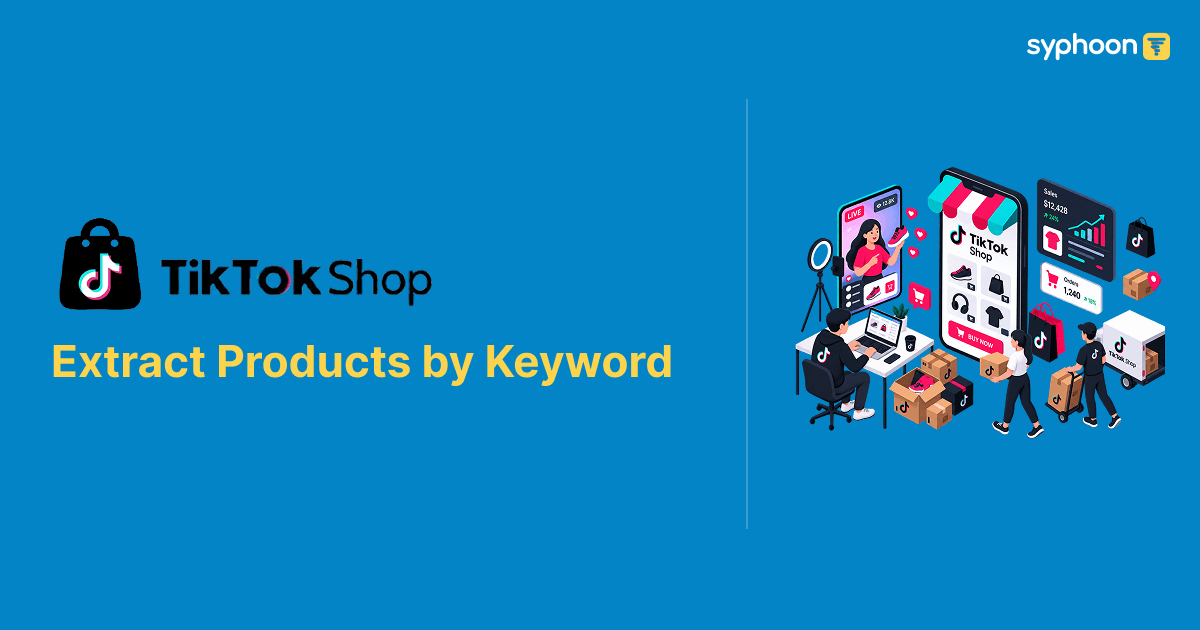
When you search "iphone case" on TikTok Shop, you don't get one seller's listing. You get a mix of dozens of shops competing for the same buyer, at prices from under $5 to over $20 for what's functionally the same clear TPU case. Some of those listings have sold thousands of units with real reviews behind them. Others have sold a handful and haven't collected a single rating yet.
A single product-detail lookup can't show you any of that, because it only tells you about one listing you already picked. Search is where you'd actually go to answer a different question: who's competing for this keyword right now, and how are they priced against each other. That's what a TikTok Shop US search scraper is for. You send a keyword, you get back the same result set a shopper would see, structured as data instead of a scrolling feed.
What a Keyword Search Actually Returns
A search request takes a keyword and returns a list of matching products, each with pricing, seller identity, rating, and sales volume. Running the keyword "iphone" returned 15 products in this sample, spanning phone cases, refurbished devices, and accessories, since TikTok Shop's search matches broadly on keyword text rather than filtering to a single product category.
| Field | What It Contains |
|---|---|
| product_id | TikTok Shop's unique identifier for the listing |
| title | Full product title as shown in search results |
| canonical_url | Direct link to the product page |
| image | Primary listing image URL |
| sale_price_decimal / sale_price_format | Current price shown to the buyer |
| price_prefix | "From" when the listing has multiple variants at different prices, absent for single-price listings |
| rate_info.score / review_count | Average rating and number of reviews, where available |
| sold_info.sold_count | Units sold for that listing |
| seller_info.seller_id / shop_name | The seller behind the listing |
| marketing labels | Badges shown on the listing, such as free shipping |
| load_more_params | Pagination token/offset for retrieving further results |
Two Real Listings From the Same Search
Here's what two actual results look like for the keyword "iphone," pulled through Syphoon's TikTok Shop search API:
1{
2  "product_id": "1732167632710439753",
3  "title": "D-Drake IYRTITL Trendy Multi-Model Cellphone Case...",
4  "canonical_url": "https://shop.tiktok.com/us/pdp/trendy-d-drake-album-phone-case-for-iphone-17-7-series-anti-drop-mat/1732167632710439753",
5  "sale_price_format": "5.83",
6  "price_prefix": "From",
7  "rating_score": 0,
8  "review_count": "0",
9  "sold_count": 4,
10  "seller": "winkstores",
11  "marketing_labels": ["Free shipping"]
12}1{
2 "product_id": "1731173030443914237",
3 "title": "Clear Phone Case Compatible with iphone 17, 16, 15...",
4 "canonical_url": "https://shop.tiktok.com/us/pdp/clear-phone-case-for-iphone-16-15-14-13-12-11-xsmax-great-gift-for-friends-family/1731173030443914237",
5 "sale_price_format": "7.90",
6 "rating_score": 4.5,
7 "review_count": "18",
8 "sold_count": 238,
9 "seller": "ZenithCase",
10 "marketing_labels": ["Free shipping"]
11}These two listings sit next to each other in the same search results, and the difference between them is the whole point of pulling search data instead of just checking a product you already know about. The D-Drake case is priced lower but has zero reviews and 4 units sold. The ZenithCase clear case costs about two dollars more, has a 4.5 rating from 18 reviews, and has sold 238 units. If you were only monitoring one of these two listings, you'd have no way to know the other one exists, let alone that it's outselling the first by a wide margin at a higher price.
The "From" Price Is Worth Understanding Before You Build Anything on It
Notice the D-Drake listing has a price_prefix of "From" and the ZenithCase listing doesn't. That's not random. TikTok Shop listings with multiple variants, different colors, sizes, or models, show the lowest variant price in search results with a "From" prefix attached. A listing without that prefix is either single-variant or has all variants priced the same. If you're building a price-comparison tool off search data and you treat every sale price the same way, you'll end up comparing a starting price against a flat price without realizing it. Worth checking for that prefix before drawing conclusions from a price difference.
Struggling with TikTok Shop keyword search data and price parsing?
Why Search Data Matters Beyond Just Finding Products
A single search run tells you who's currently ranking for a keyword and at what price. Run the same search repeatedly and you start seeing something more useful: which sellers are climbing in sold count week over week, whether new listings are entering the results, and whether the price spread across competing sellers is widening or narrowing. None of that shows up from checking one product page. It only shows up when you're looking at the full competitive set a shopper would actually see.
This also matters for anyone trying to figure out who they're up against before they've picked a specific competitor to track. If you're about to list a product and don't know who's already selling into that keyword, running the search first tells you the field before you commit to pricing.
Keyword Suggestions as a Companion Signal
Alongside straight search, TikTok Shop also surfaces keyword suggestions for a given search term. For "iphone," that returns a list including "iphone 17 pro max cases," "iphone 16 pro max phone case," and "iphone case," the kind of related terms shoppers are actually typing. This is useful for finding adjacent search terms worth monitoring that you wouldn't have thought to search directly, and for understanding which specific product variations, a particular model, a particular case style, are generating enough search volume to get their own suggested term.
Handling Pagination
The sample search returned 15 results with no further pages available. For keywords with larger result counts, the response carries an offset and page token you pass into the next request to continue paging through results. Walking through multiple pages rather than stopping at the first one matters if you're trying to build a complete picture of who's competing for a keyword, since the first page alone may only show a fraction of active sellers. The TikTok Shop Keyword Search API documentation provides full details on pagination parameters.
Building This Into an Ongoing Search Monitoring Setup
A single search request is a snapshot. Running the same keyword on a schedule, storing each result set with a timestamp, and comparing runs over time is what turns it into monitoring. That's how you catch a new seller entering a keyword's results, a price shifting on an existing listing, or a sold count climbing fast enough to be worth watching closely.
Syphoon runs keyword searches against TikTok Shop US on the terms and schedule you specify, and returns the fields above in consistent structure per result. Pagination, request timing, and the underlying access work happen on Syphoon's side, so what you get is the data itself rather than a scraper you have to keep maintaining as TikTok's frontend changes. For a deeper dive into what you can extract from individual product pages, check out the TikTok Shop Product Details Scraper guide. The TikTok Shop Product Details API complements the search API by letting you pull full specifications and variant-level data from any product URL.
Track TikTok Shop search results for the keywords that matter to your category. Syphoon's TikTok Shop search scraper handles pagination and repeated collection so you get structured, comparable data instead of a scraper to maintain. Get started through our contact form.
Need scalable TikTok Shop US search scraper access?
Scale Your Web Data Collection with Syphoon
Don't let complex bot protections and proxy management slow down your business. Use Syphoon's enterprise-grade infrastructure to extract structured web data at any scale.
Frequently Asked Questions
Join Our Community
Connect with our team, discuss your use case, ask technical questions, and share feedback with a community of people working on similar problems.