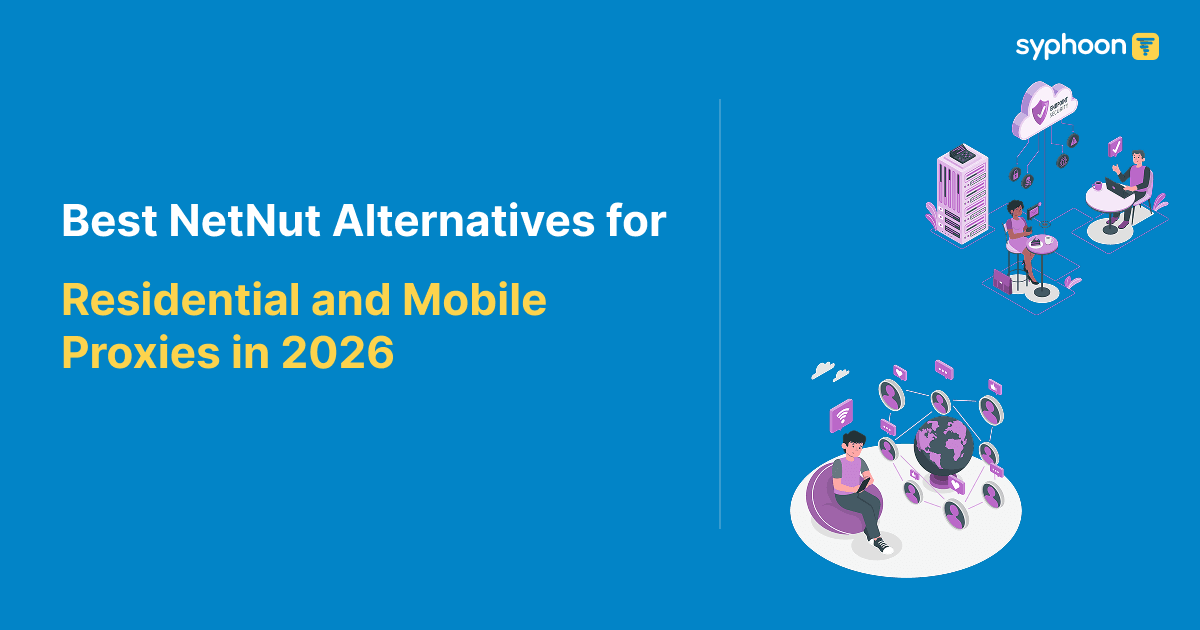
NetNut replacement has picked up urgency following the law enforcement action affecting NetNut's infrastructure in early July 2026.
This guide will help you compare the residential and mobile proxy providers who are worth evaluating now.
What NetNut Offers
NetNut was a proxy provider built around static residential (ISP) proxies sourced directly through internet service providers, alongside rotating residential, datacenter, and mobile proxy products. It has historically been positioned on fast, single-hop connectivity and a large IP pool, and is popular for ad verification, price monitoring, and social media management. It is operated by Alarum Technologies, a publicly traded company.
What to Look for in a NetNut Alternative
Before comparing specific providers, it helps to know which factors actually separate reliable proxy providers from the rest, rather than just reading well on a pricing page.
- IP pool size and diversity: a bigger number matters less than how the pool is distributed across the countries, cities, and ASNs you actually need to hit.
- Geo-targeting granularity: country-level targeting is standard. City, ZIP code, and ASN-level targeting is what separates providers on harder targets. You can check our proxy locations to see the level of detail we offer.
- Pricing model: per-GB, per-IP, and subscription models all shift the total cost differently depending on whether your traffic is steady or bursty.
- Protocol support: HTTP, HTTPS, and SOCKS5 support determines what you can plug the proxy into without extra middleware.
- Success rate and uptime: published success rates vary in how they are measured, so treat them as a starting point and validate against your own targets.
- Mobile coverage: not every residential proxy provider also runs a dedicated mobile IP pool, and mobile-specific targets often need one. Our mobile IPs are built for exactly this purpose.
- Onboarding friction: some providers require KYC review and sales calls before you get access; others let you sign up and start sending requests in minutes.
Quick Comparison
Here is how the leading NetNut proxy alternatives stack up against each other and against NetNut competitors more broadly, on pool size, mobile coverage, and how each one bills.
| Provider | Residential Pool | Mobile Proxies | Pricing Model | Best For |
|---|---|---|---|---|
| Syphoon | Global residential coverage plus a dedicated mobile pool | 25M+ mobile IPs | Predictable monthly plans, no hidden charges | Teams that want proxies and a scraper API in one account |
| Bright Data | 400M+ IPs, 195 countries | Yes, dedicated mobile network | Per-GB bandwidth pricing with volume discounts on committed plans | Enterprise scale and the widest geo coverage |
| Oxylabs | 175M+ IPs, 195 countries | Yes | Per-GB bandwidth pricing, positioned at the premium end | Compliance-heavy enterprise teams |
| Decodo | 125M+ IPs, 195+ locations | Yes | Per-GB bandwidth pricing, positioned below Tier-1 rivals for a comparable pool size | A large pool at a lower price point |
| IPRoyal | 32M+ IPs, 195+ countries | Yes | True pay-as-you-go, non-expiring traffic balance | Budget-conscious, pay-as-you-go buyers |
1. Syphoon: Best Overall NetNut Alternative
Syphoon covers residential and mobile proxies alongside a scraper API, so teams that want proxy infrastructure and a managed collection layer do not need to run two separate vendor relationships. The mobile pool runs to more than 25 million IPs, both HTTP(S) and SOCKS5 are supported, and billing is structured around predictable monthly plans rather than a pure per-GB model. For teams already comparing proxy providers against scraper APIs, that combination is the main practical difference from single-purpose proxy vendors.
2. Bright Data
Bright Data runs the largest published residential pool in the market, at over 400 million IPs across 195 countries, with targeting down to city, ZIP code, and ASN level. It bills by bandwidth, with volume discounts available on committed plans, and pairs its proxy network with a Web Scraper IDE, SERP API, and Web Unlocker for teams that want a full data collection stack. Onboarding is heavier than most alternatives on this list, with KYC checks and account review standard for new business accounts.
3. Oxylabs
Oxylabs publishes a 175 million-plus residential IP pool and positions itself around enterprise compliance, holding ISO/IEC 27001 certification and membership in industry ethical sourcing initiatives. Self-serve plans are available alongside enterprise contracts, and city-level targeting is included. It is a strong fit for regulated buyers who need documented sourcing and compliance paperwork alongside the proxy service itself, though it is generally positioned above budget-tier providers on cost.
4. Decodo
Decodo, formerly Smartproxy, offers one of the larger residential pools on the market at 125 million-plus IPs across 195-plus locations, positioned meaningfully below Bright Data and Oxylabs on cost at a comparable pool size. It holds ISO/IEC 27001 certification, supports city, state, ZIP, and ASN-level targeting at no extra cost, and includes a free trial. For teams that want Tier-1 pool size without Tier-1 pricing, this is usually the first name that comes up.
5. IPRoyal
IPRoyal runs a smaller residential pool, at roughly 32 million IPs, but leads on billing flexibility: true pay-as-you-go with no monthly commitment, and non-expiring traffic that does not reset on a monthly cycle. It is a reasonable fit for smaller teams or variable workloads where a large enterprise pool is not the deciding factor, though success rates on the most heavily protected targets tend to trail the larger Tier-1 pools.
Switching Providers Without Breaking Your Pipeline
Moving from one proxy provider to another is usually a smaller change than it feels like upfront, provided the switch is staged rather than done all at once.
- Map your current integration first: note the gateway, port, authentication method, and session type (rotating or sticky) your existing setup depends on. Our documentation is a great resource for understanding how to configure these parameters.
- Run the new provider in parallel: point a small share of traffic at the new proxy while the rest keeps running on the old one, rather than cutting over all at once.
- Check geo-targeting parity: confirm the new provider supports the same country, city, or ASN-level targeting your current workflows rely on before you migrate anything production-critical.
- Watch success rate during rollout: compare block rates and response times against your baseline for at least a few days before decommissioning the old provider.
Ready to Compare Syphoon's Proxies Against Your Setup?
Reach out to our engineering team to evaluate Syphoon's residential and mobile proxy pools with your actual scraping workloads.
Frequently Asked Questions
Join Our Community
Connect with our team, discuss your use case, ask technical questions, and share feedback with a community of people working on similar problems.