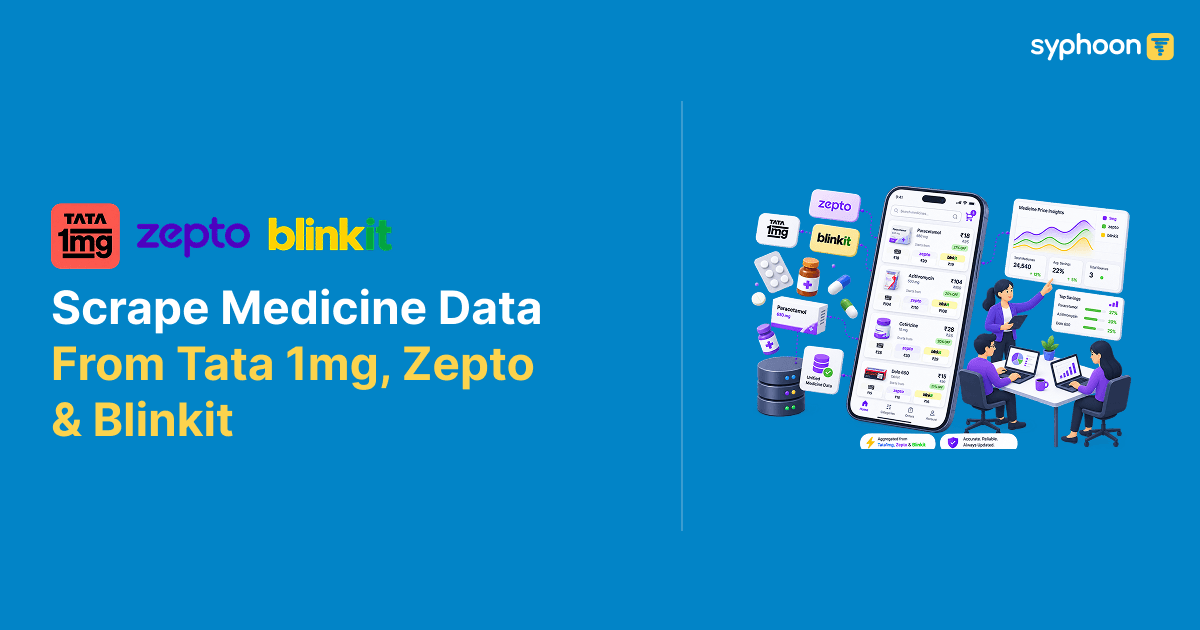
If you sell a medicine or health product on Tata1mg, Zepto, and Blinkit, you're effectively running three separate stores. from all three platforms to track how prices, stock, and availability differ. The price you set on one doesn't carry over to the others. A dark store three kilometers away can be sold out while the one next to it has twenty units sitting on a shelf.
A competitor can start a discount on Blinkit on Tuesday and you won't see it unless you're looking at Blinkit specifically on Tuesday. Most brands find out about a competitor's move a week later, when sales have already dipped and someone finally checks why.
Getting ahead of that means pulling price, stock, and discount data from all three platforms regularly, comparing it to your own listings, and actually looking at it often enough that a week doesn't pass before you notice something changed. It's not a complicated idea. What makes it hard is that Tata1mg, Zepto, and Blinkit don't hand you comparable data. They structure things differently enough that a script written for one will quietly break or mislead you on another. This piece focuses on those three since they cover most of the medicine and health-nutrition volume in quick commerce and online pharmacy today, though Instamart, PharmEasy, and Netmeds carry similar categories and are worth watching too if your competitive set sells there.
What You're Actually Trying to Catch
The obvious thing to track is price. Less obvious, and often more useful, is stock. A competitor sitting at zero units in a dark store is a window. If you're in stock and roughly competitive on price at that moment, you're the one showing up when someone searches that pincode. That window can close in hours, so checking once a week doesn't catch it. Checking daily might not either, depending on how fast your category moves.
Discounts are worth separating from price. Two competitors can land at the same shelf price and mean completely different things by it. One might just price low as a baseline, no discount tag, nothing dynamic about it. Another might be at a similar price but running a visible markdown, which usually means they're pushing to clear stock or hit a campaign target, and that price won't hold. If your dashboard just shows a flat number for both, competitor price 599 rupees, you're missing the part that tells you whether that price is going to stick around.
What the Data Actually Contains
All three platforms return a comparable core: product identity, category, price, stock, and location. But the exact fields, and how granular they are, differ by platform.
| Field | Tata1mg | Zepto | Blinkit |
|---|---|---|---|
| Category depth | Category, Subcategory, Child Category (3 levels) | Category, Subcategory (2 levels) | Category only (1 level) |
| Location input | Area/city name (no pincode field) | Pincode | Pincode |
| Store identifier | Not applicable (no dark store model) | Dark store ID | Dark store ID |
| Price fields | Selling Price, Final Price | Selling Price, Final Price | Selling Price, Final Price |
| Stock field | Numeric stock count and availability status | Numeric stock count and availability status | Numeric stock count and availability status |
| Promotional offer format | e.g. "18% off" or "No Offer" | e.g. "Product Discount; Rs.293.0" | e.g. "15% OFF" or "No Offers" |
| Product identifiers | SKU/Product ID, Product URL | SKU/Product ID, Product URL | SKU/Product ID, Product URL |
| Size/variant | Product Size / Variant | Product Size / Variant | Product Size / Variant |
| Search metadata | Input Location only, no keyword field | Input Keyword, Input Location | Input Keyword, Input Location |
The location input row matters operationally, not just as trivia. Tata1mg doesn't accept a pincode directly on their search flow. It only works off named areas or cities. So a pincode-level tracking setup that treats all three platforms as pincode-in, pincode-out breaks on Tata1mg specifically. You need a pincode-to-area mapping step for Tata1mg that Zepto and Blinkit don't require, since both of those accept the pincode natively.
The promotional-offer field is a smaller but real annoyance if you're normalizing data across platforms. Zepto writes it as a currency-off string, Blinkit as a percentage string with a different casing, Tata1mg as a plain percentage. None of them use the same format, so a discount-tracking dashboard pulling from all three needs a parsing step per platform before the numbers are comparable.
Every record also carries a SKU or product ID, a direct product URL, the size or variant of the item, and a UTC timestamp. The timestamp does most of the work here. A single price point tells you almost nothing on its own; the same field checked repeatedly and stamped with when it was pulled is what lets you see a price move or a stockout as it happens instead of guessing after the fact once someone finally notices. The SKU and product URL matter for a more basic reason: without a stable identifier, you can't reliably tell whether today's price for a competitor's product is the same listing as yesterday's, particularly when a product's size or variant changes between checks. Zepto and Blinkit also log the keyword and location used for that specific search, so a result can be traced back to the query that produced it. Tata1mg logs the location only, since its results come from browsing a category rather than a keyword search.
Need to scrape medicine & health product data from Tata1mg, Zepto, and Blinkit?
What the Output Actually Looks Like
Here's the field structure Syphoon returns per platform. The values below are illustrative, standing in for whatever product and category you're actually tracking, not a specific real listing:
// Tata1mg
1{
2  "sku_product_id": "[SKU / product ID]",
3  "product_name": "[product name]",
4  "brand": "[brand name]",
5  "category": "[category]",
6  "subcategory": "[subcategory]",
7  "child_category": "[child category]",
8  "product_size_variant": "[size or variant]",
9  "product_url": "[product page URL]",
10  "selling_price": 000,
11  "final_price": 000,
12  "stock_availability": 0,
13  "availability_status": "In Stock",
14  "promotional_offers": "[e.g. 18% off, or No Offer]",
15  "location_information": "[area/city]",
16  "input_location": "[area/city used in search]",
17  "timestamp_utc": "[ISO 8601 timestamp]"
18}
// Blinkit
1{
2  "sku_product_id": "[SKU / product ID]",
3  "product_name": "[product name]",
4  "brand": "[brand name]",
5  "category": "[category]",
6  "product_size_variant": "[size or variant]",
7  "product_url": "[product page URL]",
8  "selling_price": 000,
9  "final_price": 000,
10  "stock_availability": 0,
11  "availability_status": "available",
12  "promotional_offers": "[e.g. 15% OFF, or No Offers]",
13  "dark_store_identifier": "[store ID]",
14  "location_information": "[full address string]",
15  "input_keyword": "[search term used]",
16  "input_location": "[pincode used in search]",
17  "timestamp_utc": "[ISO 8601 timestamp]"
18}
// Zepto
1{
2  "sku_product_id": "[SKU / product ID]",
3  "product_name": "[product name]",
4  "brand": "[brand name]",
5  "category": "[category]",
6  "subcategory": "[subcategory]",
7  "product_size_variant": "[size or variant]",
8  "product_url": "[product page URL]",
9  "selling_price": 000,
10  "final_price": 000,
11  "stock_availability": 0,
12  "availability_status": "Available",
13  "promotional_offers": "[e.g. Product Discount; Rs.X.0]",
14  "dark_store_identifier": "[store ID]",
15  "location_information": "[locality, city, state]",
16  "input_keyword": "[search term used]",
17  "input_location": "[pincode used in search]",
18  "timestamp_utc": "[ISO 8601 timestamp]"
19}
The same product can carry a different category label on each platform, since none of the three use the same taxonomy. Tata1mg tends to be the most structured of the three, with proper category and subcategory depth for most health-related items. Zepto and Blinkit lean on flatter, more grocery-style tagging, which means the same product can land somewhere unexpected on one platform while sitting neatly on Tata1mg. If you're grouping competitor products by category name to build a comparison set, this is worth accounting for. Category tags aren't a reliable join key across all three platforms, so building your own product-to-category mapping, separate from whatever label each platform assigns, tends to work better than trusting the platform's own categorization to line up.
What the Stock and Price Fields Are Good For
Blinkit and Zepto report stock per dark store, and dark stores by design hold thin inventory, often single digits to low teens per SKU. Tata1mg isn't running the same dark-store model, so its stock numbers tend to run higher. That difference changes what a given number means: a Blinkit competitor down to 1 or 2 units is a near-term stockout worth acting on, while a Tata1mg competitor at a similar low count isn't necessarily signaling the same thing.
Discount formatting also isn't consistent across the three. Tata1mg tends to show a plain percentage or mark an item as having no offer. Zepto writes discounts as a currency amount off. Blinkit uses a percentage in its own format. A dashboard pulling from all three needs to normalize these into one comparable figure, since none of the raw strings match each other directly.
Building a Pipeline Across All Three Platforms
Tracking medicine and nutrition pricing across all three platforms means handling three different location inputs, three different category structures, and three different discount formats. The practical approach is to pull the data as each platform gives it to you, then normalize afterward, rather than trying to force all three into one shape upfront.
Syphoon runs this collection across Tata1mg, Zepto, and Blinkit on the pincode and keyword combinations you specify. The output keeps each platform's quirks visible, including area-based location on Tata1mg and dark store IDs on Zepto and Blinkit, instead of flattening everything into a single format before you've had a chance to see what's actually different. This approach also supports Q-Commerce Intelligence: Track Blinkit, Zepto & Instamart, helping brands monitor pricing, availability, promotions, and competitive changes across major quick-commerce platforms.
Frequently Asked Questions
Track Medicine & Health-Nutrition Pricing Across Platforms
Syphoon handles platform-specific location inputs, category structures, and data formatting so your team works from one consistent dataset across Tata1mg, Zepto, Blinkit, Instamart, PharmEasy, and Netmeds.