Walmart has grown into the second-largest ecommerce platform in the United States, and the gap with Amazon is narrowing. As more brands and sellers expand across both platforms, the same product increasingly shows different prices, availability, and seller activity depending on where you look. A competitor holding price on Amazon may be running a discount on Walmart. A product that appears out of stock on one platform may be fully available on the other.
For data teams building pricing or monitoring systems, collecting from one platform while ignoring the other produces an incomplete picture.
Syphoon's Walmart Scraper API returns structured product data from any Walmart product or search page, covering pricing, availability, seller information, ratings, and specifications, giving teams the Walmart side of that picture without building or maintaining their own scraper.
What the Walmart Scraper API Returns
The API supports two request types: product page requests for detailed data on a specific listing, and search page requests for category-level competitive data.
Product page data
| Field | Description |
|---|---|
product_name | Full product title as listed on Walmart |
brand | Brand name |
product_id | Walmart's unique product identifier |
product_url | Direct link to the product listing |
price | Current listed price |
images | Product image URLs |
product_description | Full listing description text |
feature_list | Bullet point features from the listing |
specifications | Structured technical attributes |
sizes | Available size options where applicable |
colors | Available colour options where applicable |
seller_name | Name of the seller offering the product |
product_rating | Average star rating from buyers |
number_of_reviews | Total customer review count |
Search page data
Pass a Walmart search URL and the API returns all products in the search results with the same core fields per listing. This supports category-level monitoring without requiring a pre-built product ID list.
Need to scrape product data from Walmart at scale?
Making a Request
Endpoint: https://api.syphoon.com (POST request, JSON body, three fields: the Walmart product or search URL, your Syphoon API key, and method set to GET).
Product page request
1import requests
2
3payload = {
4    "url": "https://www.walmart.com/ip/product-name/123456789",
5    "key": "YOUR_SYPHOON_KEY",
6    "method": "GET"
7}
8response = requests.post("https://api.syphoon.com", json=payload)
9if response.status_code == 200:
10    data = response.json()
11    # Returns price, seller, rating, specs, and more
Search page request
1import requests
2
3payload = {
4    "url": "https://www.walmart.com/search?q=wireless+earbuds",
5    "key": "YOUR_SYPHOON_KEY",
6    "method": "GET"
7}
8response = requests.post("https://api.syphoon.com", json=payload)
9if response.status_code == 200:
10    data = response.json()
11    # Returns all products in search results with pricing and ratings
Response Status Codes
- 200Success
- 400Invalid response from Expedia (charged)
- 404Incorrect URL (charged)
- 429Concurrency exceeded
- 5xxServer error
Use Cases
Cross-platform competitor price monitoring
Many sellers and brands monitor Amazon pricing but skip Walmart. A competitor who drops prices on Walmart without moving on Amazon is still pulling price-sensitive buyers away. Daily product page collection across both platforms gives a complete cross-marketplace pricing picture. When a product goes out of stock on Amazon, checking Walmart availability reveals whether the competitor still has inventory there.
MAP compliance on Walmart
Brands with minimum advertised price policies need to monitor Walmart as well as Amazon. The seller name field returned by the API identifies who is listing the product and at what price. Daily comparison against the MAP threshold catches violations with documented evidence for enforcement.
Product catalogue enrichment
Product description, feature list, specifications, images, sizes, and colours from Walmart product pages are directly usable for catalogue enrichment, comparison databases, and product research tools. For teams building pricing or comparison platforms that cover multiple retailers, Walmart data is a core input alongside Amazon product data.
Category and market research
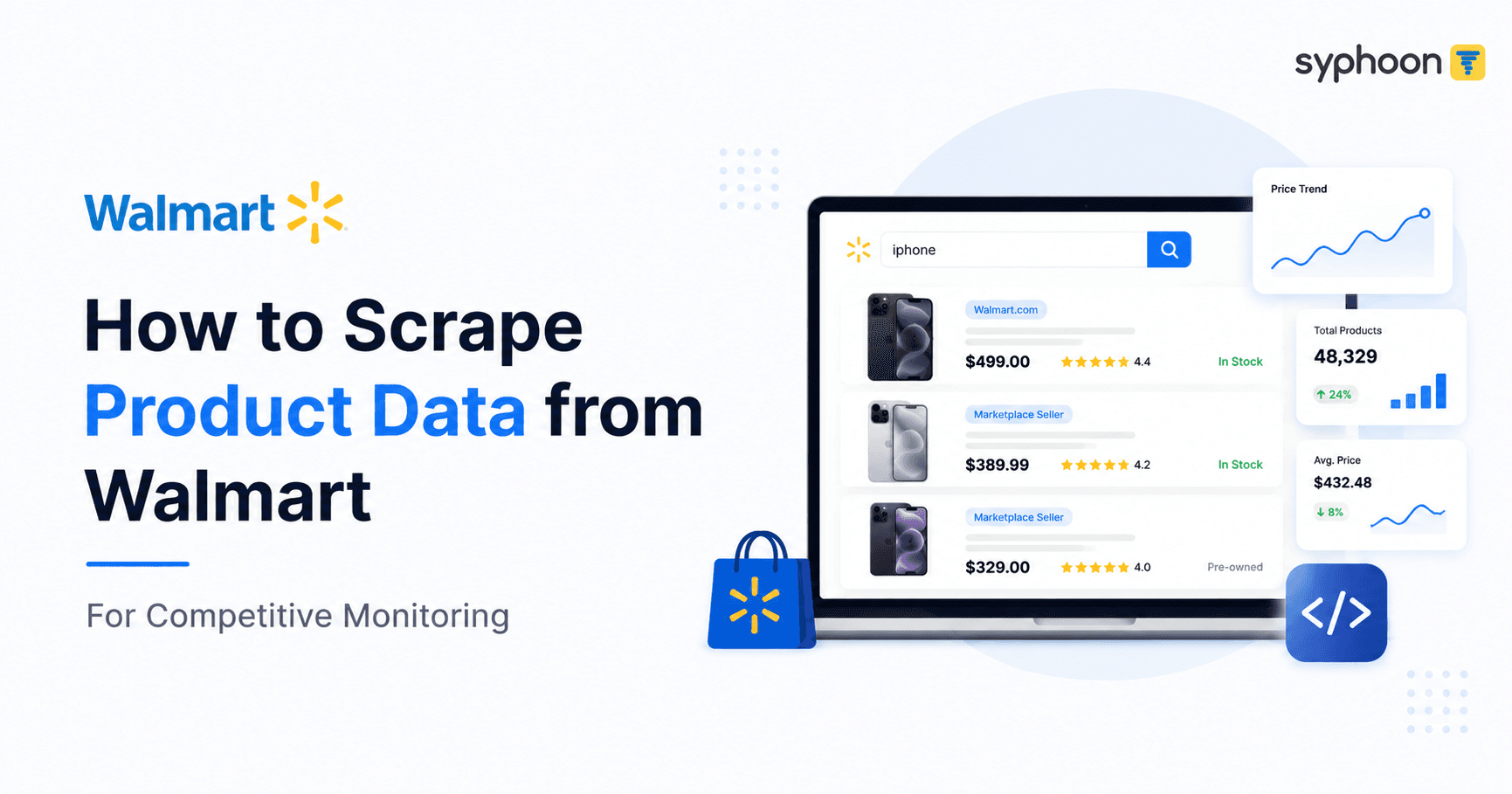
Search page requests return the full competitive set for any Walmart keyword or category. Before entering a new product category, collecting the search results shows how many products compete, what price range they occupy, which brands are present, and how ratings are distributed. This is market research that takes minutes to collect and would take days manually.
Seller and brand monitoring
The seller name field identifies who is selling a product on Walmart's marketplace. For brands distributing through authorised sellers, daily monitoring catches unauthorised listings and grey market activity. For sellers monitoring competitors, it reveals which brands are active on Walmart and at what price.
Ready to start collecting Walmart product data?
Walmart vs Amazon: Why You Need Both
| Factor | Amazon | Walmart |
|---|---|---|
| Market position | Largest US ecommerce platform | Second-largest US ecommerce platform |
| Seller model | Multi-seller marketplace with Buy Box competition | Hybrid: first-party Walmart inventory plus third-party marketplace sellers |
| Price dynamics | Prices update multiple times daily on high-demand products | Generally less volatile but moves in response to Amazon pricing |
| Data available | Price, seller offers, Buy Box, BSR, ratings, reviews, specs | Price, seller name, rating, review count, description, specs, availability |
| Why it matters for monitoring | Primary platform for most US ecommerce categories | Second price point for the same products, different seller set |
Syphoon covers both platforms through the same endpoint and request format. The same pipeline that collects Amazon product data extends to Walmart by substituting the product URL.
Scale Your Web Data Collection with Syphoon
Don't let complex bot protections and proxy management slow down your business. Use Syphoon's enterprise-grade infrastructure to extract structured web data at any scale.
FAQs
Join Our Community
Connect with our team, discuss your use case, ask technical questions, and share feedback with a community of people working on similar problems.