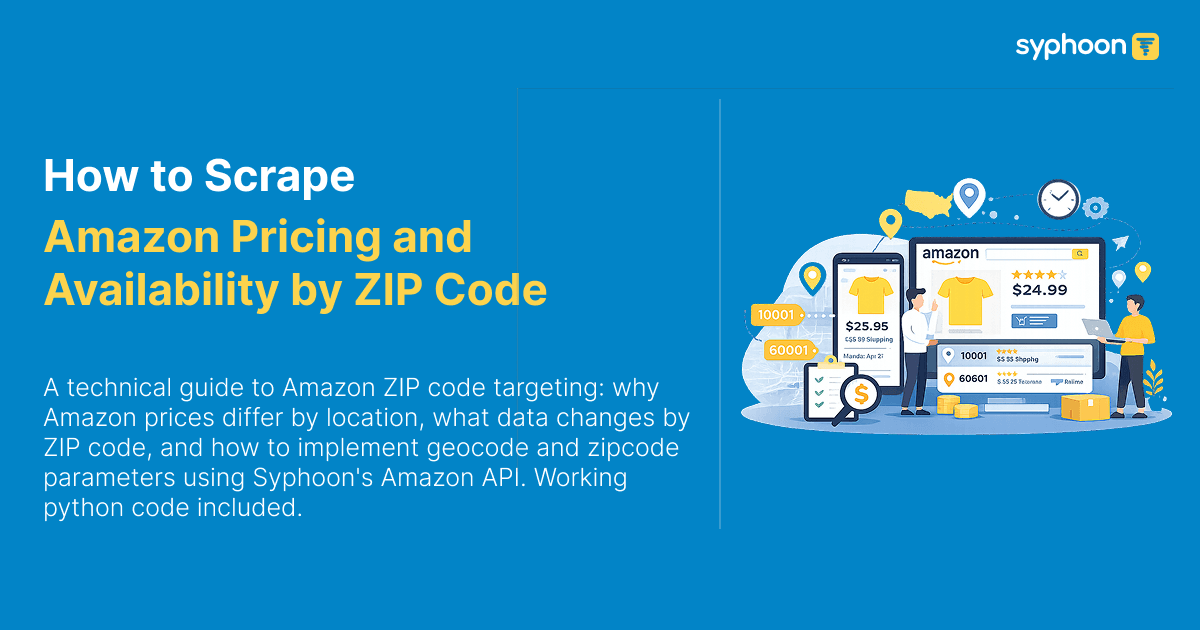
Amazon does not serve a single national price for every product. What a customer sees in ZIP 10001 in Manhattan can differ from what a customer sees in ZIP 60601 in Chicago: different sellers winning the Buy Box, different availability signals, different shipping speeds, sometimes different prices entirely.
For teams building price monitoring pipelines and competitor price monitoring infrastructure, this creates a data accuracy problem that most Amazon scrapers handle incorrectly. A scraper running from a server in Virginia returns the price and availability for Virginia's nearest fulfillment centre, then treats that as the national price. For a brand monitoring third-party seller competition across US regions, or a price intelligence platform that needs to show customers accurate local pricing, this approach produces misleading data.
The fix is ZIP code targeting: passing a geocode and zipcode parameter with every Amazon request so the returned data reflects what a customer at that location actually sees. This guide explains why Amazon pricing varies by ZIP code, what data changes when you target by location, and how to implement ZIP code targeting using Syphoon's Amazon API with working Python code samples.
Why Amazon Prices and Availability Differ by ZIP Code
Amazon's pricing and availability are not static national values. Several factors cause the same ASIN to return different data depending on the delivery ZIP code used in the request. Understanding these regional differences is central to modern ecommerce pricing strategies and competitive marketplace monitoring.
Fulfillment centre proximity
Amazon operates over 200 fulfillment centres across the US. When a customer sets their delivery address, Amazon routes their request to the nearest fulfillment centre with that product in stock. If the New Jersey fulfillment centre has a product in stock and the one in Texas does not, a customer in New York sees 'In Stock' while a customer in Dallas sees 'Usually ships in 3 to 5 days' or a different seller entirely. This is not a pricing decision, it is a logistics reality, but it directly affects what your scraper returns if you are not specifying a delivery location.
Buy Box winner varies by region
The Buy Box, the default seller shown when a customer clicks Add to Cart, is determined by a combination of factors including price, fulfillment method, seller rating, and delivery speed. Because delivery speed is proximity-dependent, different sellers can win the Buy Box in different ZIP codes for the same ASIN. A third-party seller using FBA with a fulfillment centre in the Midwest may consistently win the Buy Box in Midwest ZIP codes while losing it on the coasts. Without ZIP code targeting, your scraper returns whichever seller happens to win the Buy Box for your server's location, which may not represent any of the markets you actually care about.
Third-party seller pricing by region
Third-party sellers on Amazon set prices nationally, but their effective delivered price and Buy Box eligibility vary by region based on their fulfillment network. A seller competitive in ZIP codes near their warehouse may be uncompetitive in ZIP codes where shipping costs eat into their margin. Monitoring extra seller pricing by ZIP code reveals which sellers are undercutting your listings in specific regions, something a national price check cannot surface.
Grocery and consumables pricing
For Amazon Fresh, Whole Foods Market, and some consumables categories, Amazon applies regional pricing influenced by local supply chain costs and competitive conditions. The same grocery item can have a materially different price in a high-cost urban market versus a lower-cost suburban market. If you are building a food or grocery price monitoring tool, ZIP code targeting is not optional.
A brand monitoring its Amazon listings nationally was unaware that a third-party seller had been consistently winning the Buy Box in Midwest ZIP codes for six weeks by pricing 7% below the brand's listing. National price monitoring showed the brand's own listing as the Buy Box winner because the monitoring server happened to be on the East Coast. ZIP code-level monitoring across five regional ZIP codes would have caught this in 24 hours.
Access structured Amazon data with local pricing.
What Data Changes When You Target by ZIP Code
| Data Field | Does it vary by ZIP code? | Why it matters |
|---|---|---|
| Buy Box winner | Yes, often | Different sellers win in different regions based on fulfillment proximity |
| Buy Box price | Yes, sometimes | The winning seller's price may differ by region |
| Product availability | Yes, frequently | Stock levels vary by fulfillment centre coverage |
| Shipping speed | Yes, always | Proximity to fulfillment centre determines delivery estimate |
| Extra seller offers | Yes, sometimes | Seller competitiveness varies by their warehouse location |
| Grocery / Fresh pricing | Yes, structurally | Regional pricing applies to food and consumables categories |
| Product title and description | No | Content is nationally consistent |
| Reviews and ratings | No | Reviews are product-level, not location-level |
| Product images | No | Images do not vary by location |
For most price monitoring use cases, Buy Box winner, Buy Box price, availability, and extra seller offers are the fields where ZIP code targeting produces meaningfully different results from a generic national query.
How ZIP Code Targeting Works in Practice
Querying Amazon with a specific ZIP code requires two parameters working together: a geocode that specifies the Amazon marketplace (for example, 'us' for Amazon.com) and a zipcode that specifies the delivery location. Amazon uses these parameters to simulate the experience of a customer who has set their delivery address to that ZIP code, and returns pricing, availability, and Buy Box data accordingly.
This is technically more complex than it sounds. Amazon's product pages are heavily JavaScript-rendered, meaning a simple HTTP request to a product URL without proper browser simulation returns minimal useful data. Amazon also uses AWS WAF and sophisticated modern anti-bot systems to detect and block automated requests based on IP reputation, request headers, and behavioural patterns.
A working ZIP code targeting implementation typically requires understanding datacenter proxies vs residential proxies and how residential proxies affect geo-targeted scraping reliability.
A working ZIP code targeting implementation needs to handle JS rendering, anti-bot bypass, and correct location parameter injection simultaneously.
Syphoon's Amazon API handles all of this at the infrastructure level. You pass the geocode and zipcode parameters in your request and receive structured JSON back, with no proxy management, no browser automation, and no anti-bot maintenance on your end.
Scraping Amazon by ZIP Code Using Syphoon's API
Syphoon's Amazon API supports ZIP code targeting across product detail pages, search results, and seller offer pages. Both the geocode and zipcode parameters are required for location-accurate data. Here are working Python examples for the three most common use cases.
Teams already scraping multiple marketplaces often combine this with workflows similar to scraping Walmart product data without getting blocked to build unified retail intelligence pipelines.
Product details by ZIP code
Use this to retrieve pricing, availability, Buy Box winner, and product details for a specific ASIN at a specific delivery location.
1import requests
2import json
3
4url = "https://api.syphoon.com"
5
6payload = json.dumps({
7    "url": "https://www.amazon.com/dp/B0C7BKZ883",
8    "zipcode": "10001",
9    "key": "YOUR_SYPHOON_KEY",
10    "method": "GET"
11})
12
13headers = {
14    "Content-Type": "application/json"
15}
16
17response = requests.post(url, headers=headers, data=payload)
18print(response.json())
The response returns structured JSON including the product title, current price, Buy Box winner, availability status, and all visible seller offers for the queried ZIP code. Switch the zipcode value to query from a different delivery location.
Search results by ZIP code
Use this to retrieve Amazon search results for a keyword as seen by a customer in a specific ZIP code. Returns ranked product listings including sponsored and organic positions, pricing, and availability.
1import requests
2import json
3
4url = "https://api.syphoon.com"
5
6payload = json.dumps({
7    "url": "https://www.amazon.com/s?k=protein+chips",
8    "zipcode": "60601",
9    "key": "YOUR_SYPHOON_KEY",
10    "method": "GET"
11})
12
13response = requests.post(url, headers=headers, data=payload)
14print(response.json())
Changing the zipcode parameter lets you compare search rankings for the same keyword across different US markets. A brand ranking position 3 in New York and position 11 in Chicago for the same keyword may be experiencing a regional fulfillment or inventory issue rather than an organic ranking problem.
Scraping multiple ZIP codes in sequence
For monitoring across a list of ZIP codes, loop through your target locations and collect one response per ZIP code. This is the pattern used in production price monitoring pipelines.
1import requests
2import json
3
4API_URL = "https://api.syphoon.com"
5API_KEY = "YOUR_SYPHOON_KEY"
6ASIN_URL = "https://www.amazon.com/dp/B0C7BKZ883"
7
8zip_codes = [
9    "10001",  # New York
10    "60601",  # Chicago
11    "90210",  # Los Angeles
12    "77001",  # Houston
13    "30301",  # Atlanta
14]
15
16results = []
17
18for zipcode in zip_codes:
19    payload ={
20        "url": ASIN_URL,
21        "zipcode": zipcode,
22        "key": API_KEY,
23        "method": "GET"
24    }
25    response = requests.post(API_URL,
26        headers={"Content-Type": "application/json"},
27        json=payload)
28    data = response.json()
29    results.append({"zipcode": zipcode, "data": data})
30    print(f"ZIP {zipcode}: {data.get('price', 'N/A')} | Buy Box: {data.get('buy_box_seller', 'N/A')}")
31
32print(f'Collected data for {len(results)} ZIP codes')
Add a time.sleep(1) between requests to keep your request rate reasonable. For large ZIP code lists running on a daily schedule, consider integrating the workflow into an automated AI data pipeline rather than running requests sequentially.
Need to test Amazon data across specific ASINs and ZIP codes?
Supported Amazon Marketplaces
Syphoon's Amazon API supports ZIP code targeting across all major Amazon marketplaces. For Amazon India specifically, the zipcode parameter accepts Indian PIN codes, making it possible to monitor pricing and availability at the pin code level in the same way you would for Q-commerce platforms.
An FMCG brand monitoring both Amazon India and Blinkit can run location-aware queries on both platforms using the same ZIP/pincode parameter pattern described in Blinkit and Zepto pincode competitor intelligence.
| Marketplace | Location parameter | Example |
|---|---|---|
| Amazon US | zipcode (5-digit US ZIP) | 10001 |
| Amazon UK | zipcode (UK postcode) | EC1A 1BB |
| Amazon Germany | zipcode (German PLZ) | 10115 |
| Amazon India | zipcode (PIN code) | 400001 |
| Amazon Australia | zipcode (AU postcode) | 2000 |
| Amazon Canada | zipcode (CA postal code) | M5V 3A8 |
| Amazon Japan | zipcode (JP postal code) | 100-0001 |
For Amazon India specifically, the zipcode parameter accepts Indian PIN codes, making it possible to monitor pricing and availability at the pin code level in the same way you would for Q-commerce platforms. An FMCG brand monitoring both Amazon India and Blinkit can run location-aware queries on both platforms using the same ZIP/pincode parameter pattern.
Four Use Cases That Justify ZIP Code Targeting
1. Regional Buy Box monitoring
Query your top ASINs across 5 to 10 representative ZIP codes covering your key US markets: a Northeast ZIP, Midwest ZIP, Southeast ZIP, Southwest ZIP, and West Coast ZIP. Run this daily. When a third-party seller starts winning the Buy Box in a specific region, you see it the next day rather than weeks later when it shows up in your sales reports. This is the single highest-ROI application of ZIP code targeting for brands selling on Amazon.
2. Competitive price intelligence by region
Query competitor ASINs across the same ZIP code set. Compare the prices returned by region to understand whether competitors are applying regional pricing strategies or whether Buy Box variation is driven by third-party seller competition. A competitor whose effective price varies by more than 5% across regions is likely dealing with a multi-seller marketplace rather than a centralised pricing strategy, which creates different response options.
3. Availability monitoring for out-of-stock detection
Query availability signals by ZIP code for your own and competitor ASINs daily. When a competitor goes out of stock in a cluster of ZIP codes, you have a window to capture their organic search traffic with sponsored placements or to increase your own inventory in those fulfillment zones. Availability signals are fulfillment-centre-specific and only visible at ZIP code level.
4. Price monitoring tools and SaaS platforms
If you are building a price intelligence SaaS product, ZIP code targeting is increasingly a baseline expectation from buyers. Tools that monitor Amazon prices at national level are being displaced by tools that show regional pricing variation. Syphoon's Amazon API gives you the infrastructure to offer ZIP code targeting as a feature without building and maintaining the anti-bot and geo-routing layer yourself.
Getting Started with Syphoon's Amazon API
Syphoon's Amazon API supports ZIP code and geocode targeting across all major Amazon marketplaces. Product detail pages, search results, and seller offers are all accessible with location parameters. A free trial is available from the dashboard.
To discuss your Amazon data requirements, request a sample output, or explore API access options, contact the Syphoon team.
The Bottom Line
Amazon pricing and availability are not uniform across the US. Buy Box winners, availability signals, and effective prices all vary by delivery ZIP code based on fulfillment centre proximity and third-party seller geography. A scraper that does not pass a location parameter is returning data for one location and treating it as national, which produces inaccurate competitive intelligence.
ZIP code targeting fixes this. Syphoon's Amazon API makes it a two-parameter addition to every request, with no anti-bot infrastructure or proxy management required on your end.
Frequently Asked Questions
Join Our Community
Connect with our team, discuss your use case, ask technical questions, and share feedback with a community of people working on similar problems.