Zepto built its market position on a singular promise: deliver groceries within 10 minutes. This 10-minute guarantee shapes every operational decision, from dark store density to rider routing to inventory management. Unlike competitors pursuing broader strategies, Zepto's entire infrastructure optimizes for extreme speed and hyperlocal presence. Dark stores cluster within 1.5 to 2.5 kilometers of residential neighborhoods, orders get picked within 60 to 90 seconds, and riders receive assignments before items are even packed. This means Zepto operates on a fundamentally different tempo than traditional e-commerce.
Zepto is expanding beyond groceries into medicines through partnerships, Zepto Cafe for food delivery, and Zepto Pass, which now represents nearly 30 percent of its revenue. For companies monitoring Zepto and its competitors, this expansion means tracking more than product prices and inventory. Businesses also need to monitor service fees instead of surge pricing, identify where new dark stores are opening, and understand how Zepto is moving into higher-margin verticals. Zepto is not a stable player—it continues to reshape its business model and market strategy.
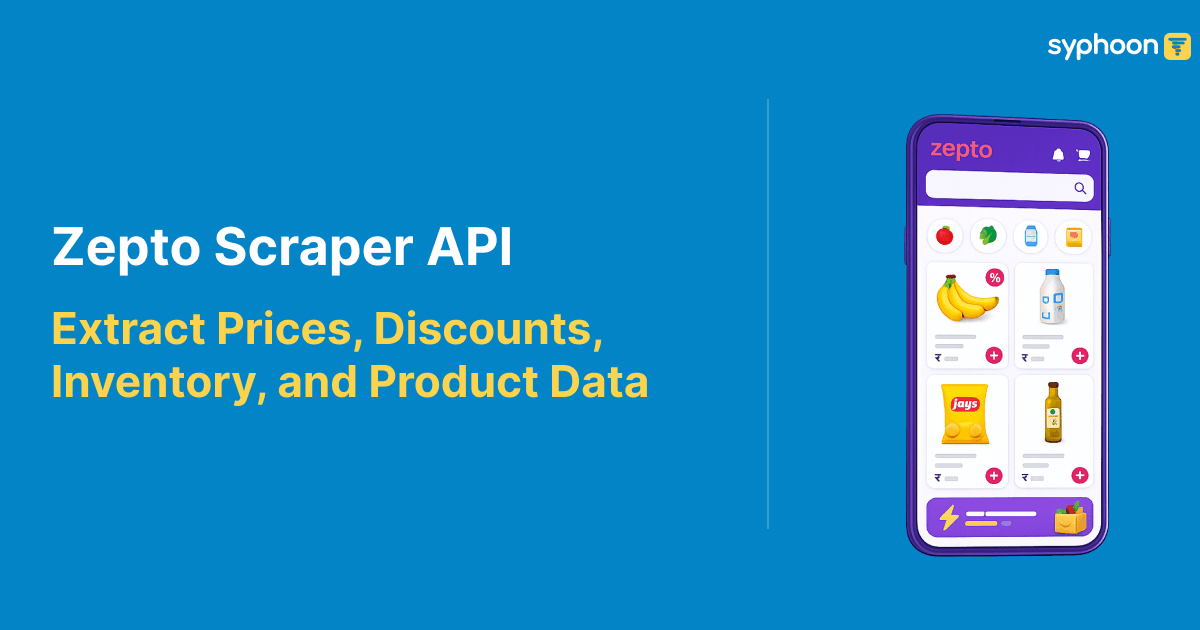
Gathering Zepto data reliably requires an approach that accounts for its hyperlocal network, rate limits, and location-specific availability. A Zepto Scraper API can help businesses collect product prices, inventory, discounts, availability, and other relevant data at scale without treating an entire city as having uniform product availability.
With Syphoon, businesses can use API-based data collection to support Zepto price monitoring, competitor analysis, inventory tracking, and market research. This guide covers what Zepto product pages show, why its operational model creates distinct challenges for data gathering, and how to build a monitoring approach that reflects Zepto's actual competitive behavior.
Need hyperlocal Zepto price and inventory data?
What Data Sits Behind a Zepto Listing
Zepto product information includes location-specific details tied to delivery zones around each dark store. Product detail pages show more comprehensive information than listing pages, so understanding the difference helps you choose the right monitoring approach for your needs. For a complete overview of what's available through our platform, visit our products page.
Product Detail Page (PDP) Data
| Data field | What it contains |
|---|---|
| Delivery Zone and Location | Delivery address, city, pincode, latitude, and longitude for the specific dark store service area |
| Product Identification | Product title, product ID, brand name |
| Pricing and Service Fees | Current price, MSRP (original price), currency, applicable service fees for this zone |
| Images | Product images and image URLs |
| Availability | Stock availability status, quantity in stock |
| Pack Size and Unit | Product pack size, unit of measurement, unit price |
| Ratings and Reviews | Product rating, number of customer reviews |
| Detailed Product Information | Full product description, key information, nutritional information (for food and health products), product attributes |
| Seller Information | Details about the brand or seller |
| Timestamps and URLs | Scrape timestamp, product URL |
Listing Page Data
| Data field | What it contains |
|---|---|
| Location and Delivery Zone | Delivery address, city, pincode, latitude, and longitude |
| Product Basics | Product title, product ID, brand name |
| Pricing and Fees | Current price, MSRP, currency, service fees |
| Images | Product images and image URLs |
| Availability | Stock availability, quantity in stock |
| Pack and Unit Info | Pack size, unit of measurement, unit price |
| Social Proof | Product rating, number of reviews |
| URLs and Metadata | Product URL, search URL that returned this result, scrape timestamp |
Product detail pages show the full picture, including detailed specifications, nutritional information, and seller details. Listing pages give you the core data for price and availability benchmarking. For competitive analysis and service fee monitoring, listing pages usually suffice. For product research or tracking Zepto's movement into medicines and new categories, you need the detailed PDP information.
Why Zepto Demands Different Monitoring Strategies
Zepto's operational model creates challenges that don't exist in traditional grocery delivery. The company operates a dense dark store network serving specific neighborhoods, which means availability and pricing are tightly bound to geography. A product available in one dark store's zone might not be available just a few kilometers away, depending on that store's inventory and what Zepto prioritizes locally. This is far more granular than standard pincode variation and requires monitoring strategies built around hyperlocal clustering.
Zepto uses service fees instead of product surge pricing, which fundamentally changes how they manage demand during peaks. Rather than raising milk prices when demand spikes at 8 AM, they adjust delivery fees based on order volume and rider availability in that zone. Monitoring Zepto means watching both product prices and service fees, since total customer cost depends on both. Service fees shift frequently and vary by zone and time, so your monitoring frequency needs to account for this volatility.
Zepto is actively expanding into medicines, ready-to-eat meals, and other non-grocery verticals, which means dark store inventories change as they test and roll out new categories. A store might suddenly start carrying pharmacy SKUs or Zepto Cafe items, shifting both product mix and margin dynamics. If you're monitoring Zepto as competition, you need to understand that their catalog and pricing strategy are evolving beyond the 10-minute grocery play.
Refresh Rates and Monitoring Strategy
Zepto's operational speed means information moves faster than in traditional e-commerce. Because items get picked within 60 to 90 seconds and orders dispatch algorithmically, inventory swings can happen within hours, especially for essentials. If you're monitoring Zepto's core staples like milk, bread, or high-demand items, hourly or 4-hour refresh cycles catch the meaningful movement. For slower-moving packaged goods or specialty items, 6-hour or daily updates usually provide enough visibility.
Service fee monitoring requires a different cadence than product pricing. Service fees shift based on real-time demand and rider availability, so understanding Zepto's demand-management strategy might mean watching service fees independently from product prices. A product price might hold stable for days, but the service fee can swing significantly throughout a single day based on delivery demand in that zone.
Monitoring Zepto's expansion into new dark stores and new verticals like medicines requires periodic broader scans rather than just watching the same SKU set continuously. Most companies benefit from combining frequent monitoring on their core competitive set with periodic broader looks to catch when Zepto opens new stores or launches new product categories. For companies tracking multiple platforms, our Walmart scraper offers similar capabilities for that retail giant.
Need automated Zepto product data extraction?
Zepto Scraper API: How It Works
Send a POST request with the target product URL, delivery zone, and your API key. Syphoon handles the dark store network infrastructure, manages rate limiting, and returns structured information tied to the specific delivery zone.
For companies monitoring multiple products in multiple Zepto zones, size your monitoring to match your coverage strategy. Whether you're watching core competitive products daily or running periodic scans for new store openings and category launches, the API adapts to your approach.
What Benchmarking Zepto Reveals
Service fee tracking across Zepto's dark store network shows how the company prices differently in different neighborhoods and manages demand through fees rather than product surge pricing. This reveals strategic positioning in each market and competitive defensibility by zone. Inventory monitoring at the hyperlocal level shows how Zepto manages stock throughout their dense network and highlights opportunities when competitors go out of stock in specific areas.
Expansion monitoring reveals when Zepto opens new stores, enters new verticals like medicines, or launches Zepto Cafe partnerships. This signals where Zepto is investing capital and what competitive dynamics might emerge. Historical analysis using regular monitoring over weeks and months uncovers demand patterns neighborhood-by-neighborhood, showing which products have seasonal swings in specific areas and how Zepto adjusts strategy by location.
When benchmarking Zepto against other major players, you can leverage tools designed for similar platforms. Our Amazon Scraper provides comparable insights for the e-commerce giant, and our comprehensive retail competitive price monitoring guide covers strategies that apply across platforms. You can also explore our guide on how to scrape Amazon ASIN data for additional marketplace intelligence.
Need to monitor Zepto's prices, service fees, inventory, and expansion throughout dark store zones?
Reach out through our contact form to learn how Syphoon's Zepto Scraper API can power your competitive intelligence.
Frequently Asked Questions
Join Our Community
Connect with our team, discuss your use case, ask technical questions, and share feedback with a community of people working on similar problems.